



STEP 01
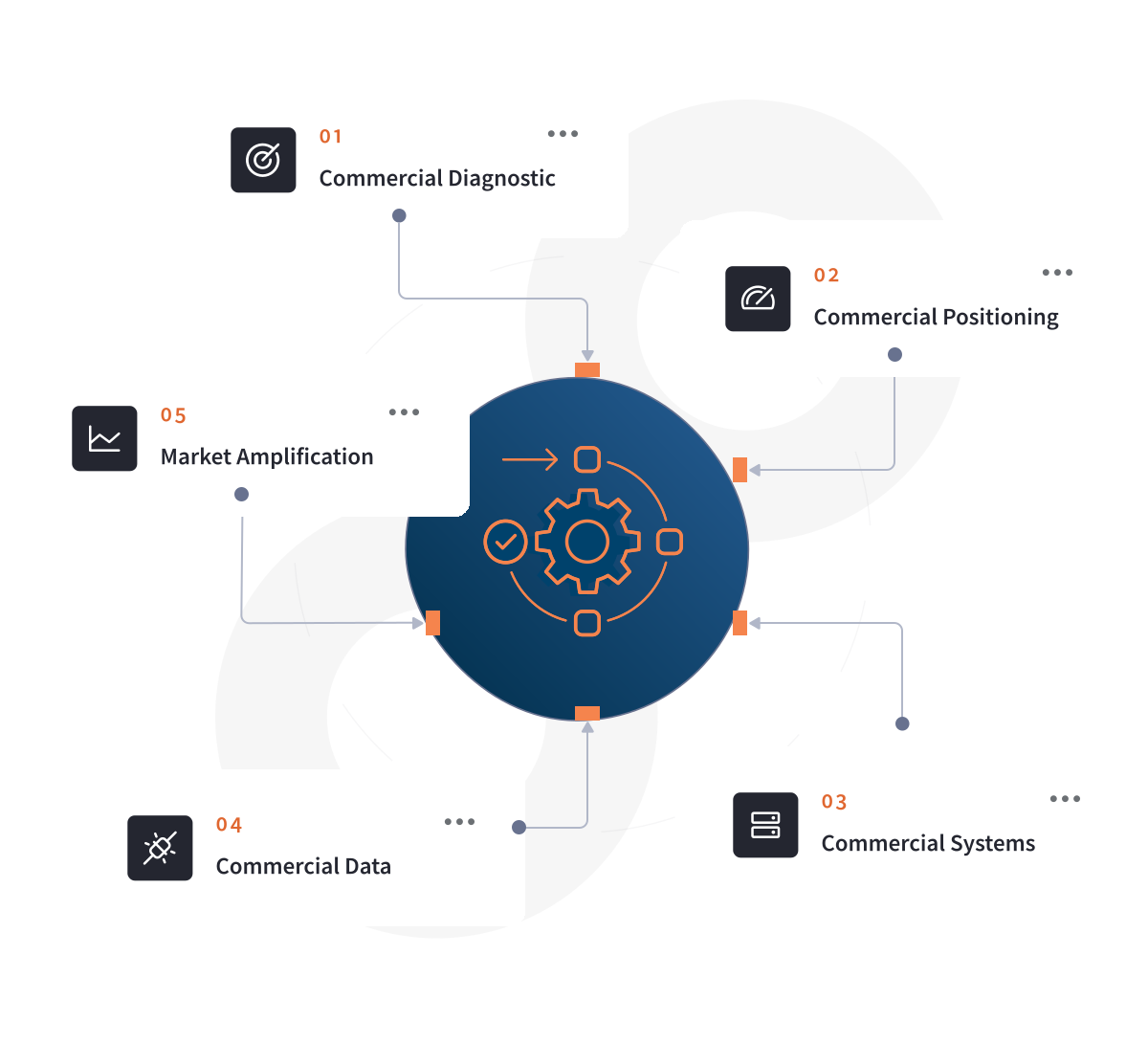
Commercial Diagnostic
A structured 90-minute workshop that gives the leadership team one shared, evidence-based view of how the front office is performing, and where it is holding growth back.
A short survey beforehand captures perspectives from the managing director to the people who sell, quote and market. It shows where views differ and where confidence is weakest. You leave with a written summary of findings.
That summary is the baseline Commercial Positioning is built from. If the Engine is not the right answer for your business, the summary says so.
WORKSHOP OUTPUT
- PIPELINE CONFIDENCE Low Views differ across teams
- POSITIONING Inconsistent No shared narrative
- DATA Fragmented Held in separate systems
- QUALIFICATION Varies Criteria differ by team
WRITTEN SUMMARY INCLUDES
- Where confidence in the front office is weakest
- Where views differ across the leadership team
- The clearest opportunities for improvement

STEP 02
Commercial Positioning
Commercial Positioning turns technical capability into a case that a buying committee can evaluate. Quality, engineering, procurement and finance each judge a supplier differently, and each can rule one out on their own.
The expertise behind that case already sits with your engineers, programme managers and commercial team. We work through it with them in facilitated sessions, then document it so it holds up in a tender, whoever is in the room.
The documented case gives sales a basis for holding price, and it is what Commercial Systems runs on.
WHAT GETS BUILT
- Where you stand Your position today, against the suppliers you meet in tenders
- Who you are for The customers worth winning, and how their buying committees decide
- Why you are chosen Technical fact turned into a case that competitors cannot copy from a spec sheet
- How it gets used The position in the hands of sales, and compiled for HubSpot


- The structured material built here is what Commercial Systems runs on.

STEP 03
Commercial Systems
Commercial Systems puts the documented case to work inside HubSpot. It has three parts that run as one: the knowledge base, the content system and the orchestration layer.
The knowledge base holds your verified positioning, specifications and compliance boundaries in HubSpot’s context layer. Agents are set to draw on that record, so proposal material, outreach and published content stay within what you have already stood behind.
The content system produces what each member of the buying committee needs, including the material sales uses with accounts. The orchestration layer connects the two, and every output passes through three layers of governance before it goes out.
Under a managed Engine, our team manages all three layers, and your domain experts confirm any new content before it enters the knowledge base. Under a supported Engine, your team holds the layers you choose.
The case stops depending on who is available to write it.
WHAT THE SYSTEM RUNS ON
- Positioning outputs Value case, narrative, buyer profiles
- Technical & compliance documentation Certifications, standards, approvals
STRUCTURED INTO
VERIFIED BOUNDARIES
Approved facts, structured so agents can read them. Agents draw on this record rather than anything else in the portal.
- Human sign-off at the points your governance rules set
- Knowledge Base Verified positioning, held in HubSpot’s context layer
- Content System Material for every member of the buying committee
- Orchestration Layer 3 layers of governance before anything goes out

STEP 04
Commercial Data
Commercial Data gives marketing, sales and leadership one audited view of the market, the pipeline and the accounts you already hold. It has two halves.
The data foundation audits and structures the records behind your CRM and forecasts. It then maps the market you can realistically win, down to a named list scored by the signals that matter in each sector. Sales sees which accounts are active now, and marketing stays present with the rest.
Commercial discipline applies the same rigour after the contract is signed. The Connected Data Loop records what accounts actually did against what the forecast said, so the next forecast starts from evidence.
For existing customers, a one-way, tokenised feed from your ERP lets only earned signals through: capacity and lead times, order and delivery status, and account margin health as a trend. No costs, no schedules, no customer IP. It is scoped with your IT team and quoted separately once your ERP is known.
The named, scored list is what Market Amplification works from.
TWO HALVES, ONE CONNECTED SYSTEM
-
DATA FOUNDATION
- Markets mapped to a named list
- Account enrichment
- Signal defined per sector
- Scoring in HubSpot
-
COMMERCIAL DISCIPLINE
- CRM data under Data Governance
- Forecast against actuals
- Margin trend on existing accounts
- The Connected Data Loop
THE RESULT
Forecasts built on clean records. Commitments checked against what the floor can deliver. Drift on existing accounts visible while there is still room to act.

STEP 05
Market Amplification
Most of your market is not buying today. When it is, it will often shortlist suppliers it already knows. Market Amplification keeps you present with the wider market, and works the named accounts when they start buying. The aim is to be considered while the specification is still open.
Account-based marketing works the named list from Commercial Data, with attention set by how much each account is worth winning. One-to-one plans are built with sales.
Paid reach carries what Commercial Systems produces to the audiences defined in Commercial Data, through LinkedIn, search and the trade press, so you stay present between buying cycles.
Answer engine optimisation covers the research buyers do on their own, so the version of your capabilities and approvals an AI engine reads is the verified one.
All three write to the same HubSpot record, so engagement and pipeline progression are reported against the same accounts.
ACCOUNT-BASED MARKETING
- One-to-one Account-specific programmes built with sales for your highest-value opportunities.
- One-to-a-few Tailored programmes for defined high-value segments and sectors.
- One-to-many Always-on activity capturing intent signals across the target market.
- PAID REACH Matched audiences and retargeting across LinkedIn, Google, and Microsoft, with sponsored placements in trade publications. Every click is recorded against the account in HubSpot.
ANSWER ENGINE OPTIMISATION
Technical expertise structured as machine-readable schema, so AI engines find, read and cite your business accurately during procurement research.