

What Happened to Inbound Marketing
The principles held. The mechanism moved.

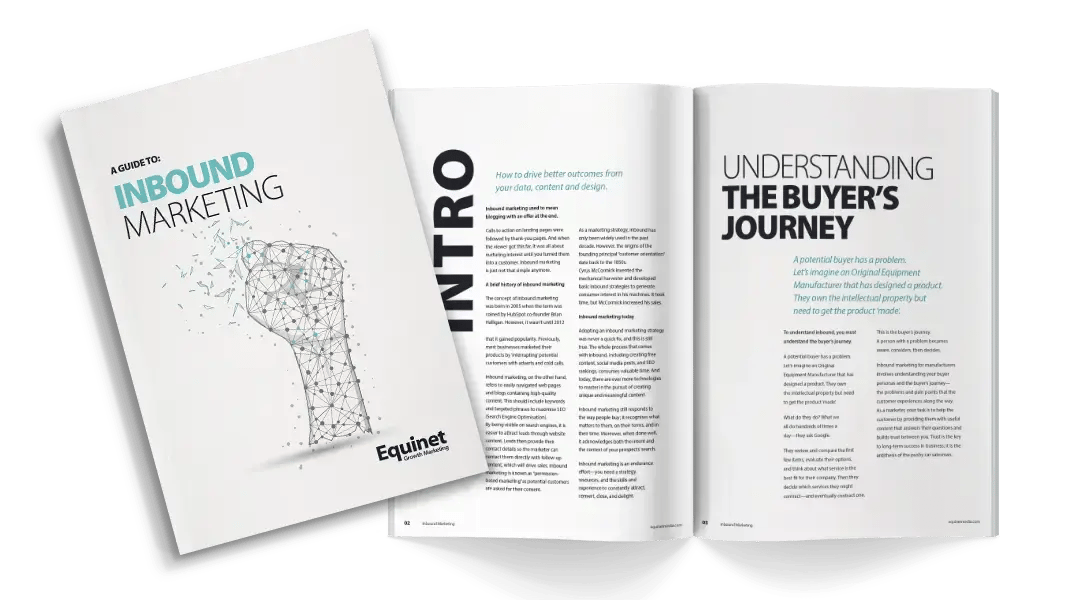
No time to read now?
What inbound marketing is
Inbound marketing is a method of attracting buyers by publishing material they find useful, so that they come to you. It was defined in opposition to outbound marketing: advertising, cold calls, and trade show stands that interrupt buyers whether or not they are looking.
Brian Halligan coined the term around 2005. He founded HubSpot with Dharmesh Shah in 2006. HubSpot’s contribution was to connect separate activities into a single method, running on one platform: blogging, search optimisation, social media, lead capture, and a CRM.
Equinet has been a HubSpot partner since 2011 and has built websites and inbound programmes for contract manufacturers since 2013. This piece is partly an account of why that work has changed.
What it got right
The idea is older than the name. Benjamin Franklin’s Poor Richard’s Almanack, John Deere’s The Furrow, and the Michelin Guide all earned attention by being useful to the people a business wanted to reach.
HubSpot gave the idea a method. Its original version ran in four stages: Attract, Convert, Close, Delight. In 2018, it replaced that funnel with a flywheel, borrowing Jim Collins’s image from Good to Great. A heavy wheel takes effort to start, then builds momentum with each push. Customers who were well served would feed new demand back into the business.
Underneath the method sat three principles. All three still hold.
Be useful. Buyers engage with suppliers who help them think through a problem before asking for anything in return.
Be found. Buyers research on their own, so a supplier’s expertise has to be where they look.
Earn trust before contact. By the time a buyer speaks to a supplier, much of the judgement has already been made. The material they read along the way shapes it.
These principles suited contract manufacturing well. Long buying cycles, technical buying groups, and customer relationships bound by NDA all reward a supplier whose thinking is visible and consistent.
What changed
The principles held. What changed is how buyers act on them, and that has consequences for the method.
The shortlist forms before anyone gets in touch. 90% of B2B buyers choose from a shortlist formed before formal evaluation begins (Bain & Google, via HBR). 81% have a preferred supplier in mind before speaking to sales (6sense). The inbound method measured success at the enquiry. For most buyers, the decision that counts has been made by then.
Research starts with AI. Around 29% of B2B buyers now begin research with AI tools (McKinsey). An AI answer condenses many sources into one response. A supplier is either cited in it or absent from it, and the buyer may never visit a website. What gets cited is material that states facts clearly and consistently, in a form an AI system can lift.
Useful content stopped standing out. When every supplier publishes helpful material, helpfulness no longer separates one from another. 68% of buyers say the suppliers they evaluate all sound and act the same, up from 60% two years earlier (Dentsu B2B Superpowers Index). For contract manufacturers, the strongest proof usually sits behind NDAs. How a supplier shows up commercially is often the only proof a buyer can see.
Channels drifted apart. Inbound added channels over time, often run by different people working from different sources. Around 70% of buyers find contradictions between a supplier’s website and what its salesperson tells them (Gartner). Each contradiction gives a buyer a small reason to doubt.
Most buyers are not looking. The method was built to meet buyers at the moment they searched. At any given moment, most of the buyers a contract manufacturer will eventually serve are not searching. Staying present with that majority matters as much as being found by the few who are in market today. A supplier that has stayed present is already familiar when a need arises.
What replaces it
The three principles still apply. What has to change is the structure underneath them.
Separate tactics, each with its own calendar and its own owner, drift apart over time. A system that draws every output from one documented source stays consistent, and improves as it learns what works.
That is the reasoning behind the Commercial Intelligence Engine. It is Equinet’s five-step method for running a contract manufacturer’s front office as a system. The Engine is a new proposition, launched in October 2026, and recent developments in the HubSpot platform made it buildable. Each step carries forward something inbound got right.
Commercial Diagnostic establishes where the front office stands today. It looks at how the company is positioned, what it publishes, how its data is kept, and where buyers lose confidence.
Commercial Positioning settles what the company says and documents it as structured fact. That covers who it serves, the problems it solves, how it reduces risk for each buyer role, and the evidence behind each claim. Every channel, every salesperson, and every AI system then works from the same facts.
Commercial Systems puts that positioning to work. A Knowledge Base holds the documented facts. A Content System produces material from them for each buyer role and stage. An Orchestration Layer decides what goes where, and when. Being useful no longer depends on someone finding time to write.
Commercial Data keeps the record of which accounts are engaging, with what, and what moves them forward. It succeeds inbound’s closed-loop reporting. It measures at the level of accounts and buying groups instead of individual form fills.
Market Amplification puts the output where buyers look, and keeps it in front of those not yet looking. Its channels are search, AI answers, LinkedIn, trade media, and advertising. Answer engine optimisation (AEO), the work of being cited accurately in AI-generated answers, sits here.
The five steps connect through the Connected Data Loop. What Commercial Data and Market Amplification learn feeds back into the Knowledge Base, so the next round of content starts from better facts. The flywheel was a good image for momentum. The loop is the mechanism that produces it.
What to keep and what to let go
Much of good inbound practice carries straight into the Engine. Some of it was tied to conditions that have moved on.
Keep
- Topic clusters. Grouping material around a central subject gives search engines and AI systems a clear map of what a company knows. It also gives the Knowledge Base its structure.
- Content for each buyer role. Engineering, quality, regulatory, and procurement each need different evidence. That remains true, and the Content System makes it practical to supply.
- Decision-enabling material. Capability detail, certifications, and plain explanations of trade-offs help a buying group reach agreement. They are also the kind of clear, factual material AI answers draw on.
- Clear next steps. Every piece should point to a logical next step that matches where the reader is.
- Closed-loop measurement. Connecting activity to pipeline still matters. Measure it by account.
Let go
- Volume as the target. A calendar measured in posts per month produces more of the material AI answers condense into a sentence. Fewer pieces, built on documented facts, serve buyers better.
- The individual lead as the unit. Buying groups make contract manufacturing purchases. Scoring one person’s form fills misses most of what is happening in an account.
- The enquiry as the finish line. The shortlist forms before contact. The work that counts happens in the months when buyers are reading, comparing, and asking AI tools.
- Channels run in isolation. Every channel should draw from the same documented facts, so the website, the salesperson, and an AI answer all say the same thing.
Where to start
Inbound gave contract manufacturers a sound set of principles. The way buyers research and shortlist suppliers has changed, and the method needs a structure that matches.
To see what the Engine is and why it works, book an Engine walkthrough. For the fuller argument behind it, read Beyond the Shop Floor.
Campaigns end. Systems compound.

Want to save a copy? Well send a copy direct to your inbox.
Resource Library