
.png?width=16&height=19&name=Icon%20(1).png)


The Front-
Office Gap in Industrial Manufacturing
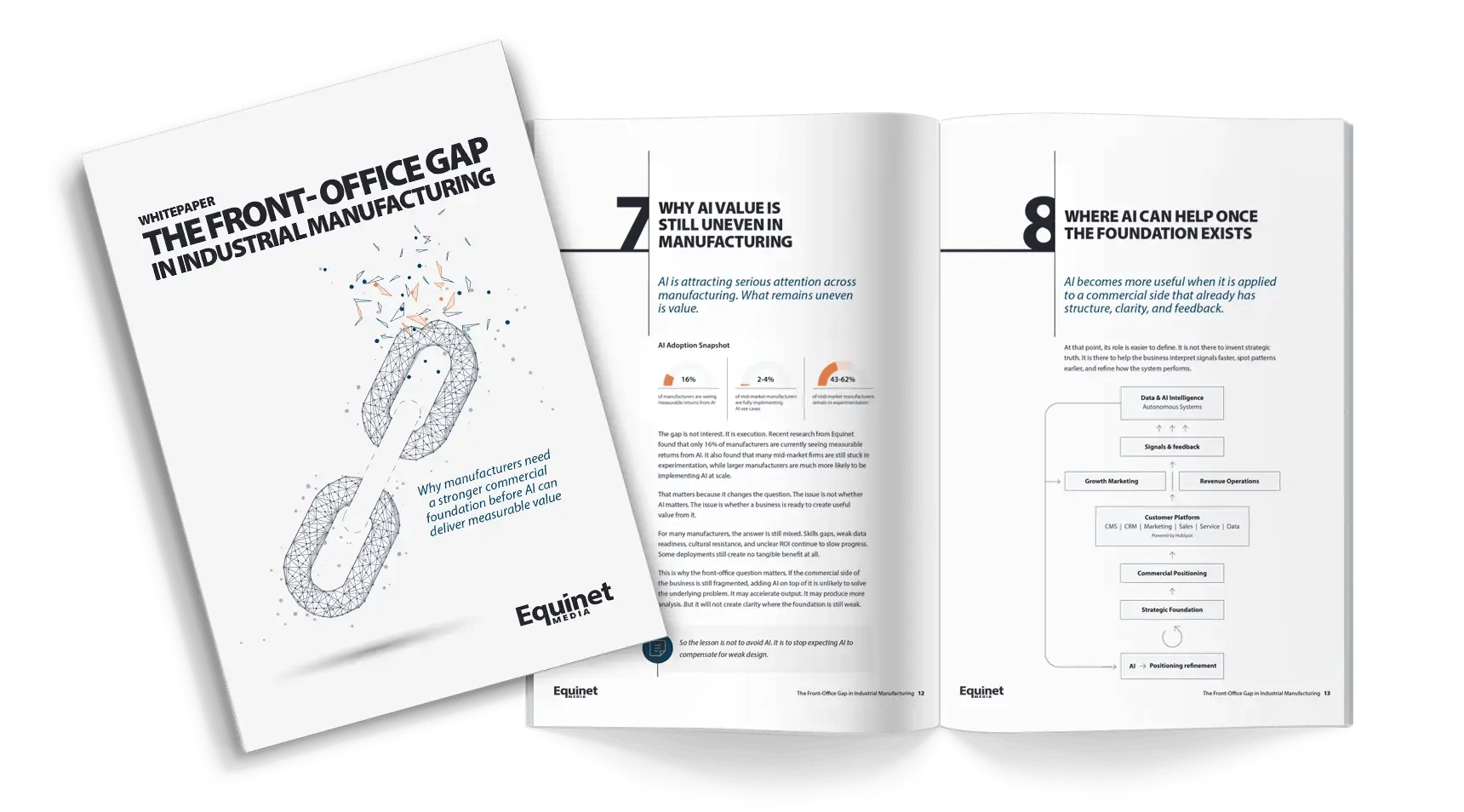
Why manufacturers need a stronger commercial foundation before AI can deliver measurable value
No time to read now?
EXECUTIVE SUMMARY
Industrial manufacturers have invested heavily in operational excellence. Far fewer have applied the same level of structure and discipline to the commercial side of the business.
The result is a front-office gap: a fragmented commercial system in which sales, marketing, the website, and leadership teams often operate in isolation rather than as a coherent whole. This can lead to inconsistent pipeline quality, weak differentiation, and limited visibility into how growth is generated.
For contract manufacturers, the challenge is more acute. With limited ability to showcase customer products or case studies, they have to work harder to clearly explain what they do and why it matters.
At the same time, many manufacturers are investing in AI. Yet returns remain uneven. Analysis presented in Equinet’s State of AI in Manufacturing report indicates that only 16% of manufacturers are currently seeing measurable value, with most mid-market firms still in the experimentation phase.
This paper argues that the issue is not a lack of tools but a lack of foundation.
Applying AI to a fragmented commercial system is unlikely to produce meaningful results. Manufacturers should instead prioritise building a stronger commercial foundation. This means clarifying where they create value, aligning how that value is expressed, and improving visibility into how opportunities are generated and progressed.
Only once this foundation is in place does AI become a meaningful tool for optimisation.
INTRODUCTION
Manufacturers have built disciplined operational systems. The next challenge is to apply that same seriousness to the commercial side of the business.
Process discipline, engineering capability, quality, and delivery remain the foundation of performance.
But operational strength does not automatically translate into commercial effectiveness. It does not ensure the business is easy to understand, visible in the right places, or able to generate and progress opportunities with consistency.
While operations are deliberately designed and continuously refined, the commercial side often develops in a more piecemeal way, shaped by immediate needs rather than an overarching system.
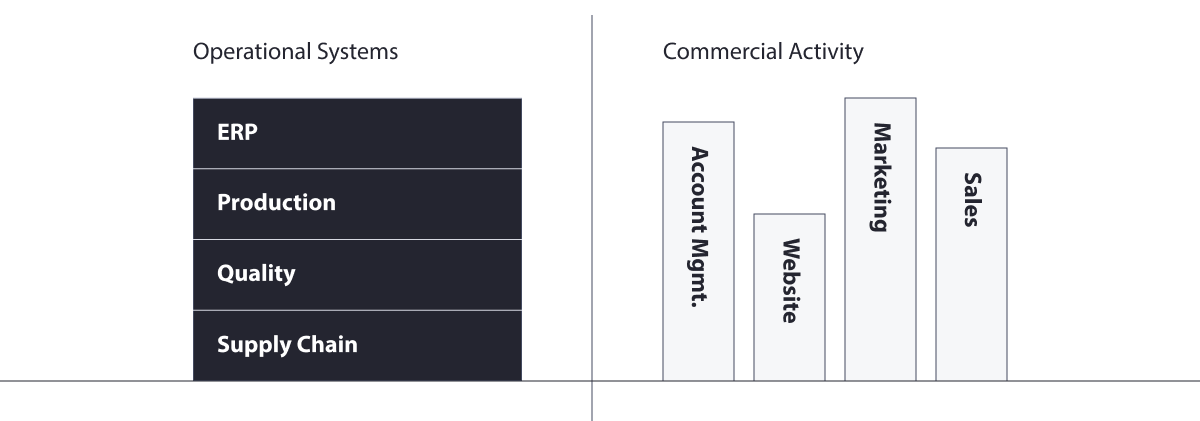
This becomes more visible as conditions change. Growth has become harder to sustain, margins are tighter, and buyers are more selective. Under these conditions, weaknesses in how the business presents itself and creates opportunities start to matter more.
If operational performance is treated as a system, why is the commercial side of the business so often not?
Here, we explore how the commercial side operates in practice, where fragmentation occurs, and why it matters more now. It also considers whether businesses are trying to apply AI before the underlying commercial structure is strong enough to support it.
1. OPERATIONAL EXCELLENCE IS NO LONGER ENOUGH
Operational excellence remains the foundation of performance. But it does not guarantee commercial clarity or predictable growth.
A business can be highly capable operationally and still struggle to explain clearly what makes it different, create visibility in the right markets, or maintain confidence in how opportunities move through the business.
That gap matters because the business consequences are real. Weak commercial visibility affects pipeline confidence, growth planning, customer diversification, and leadership decision-making.
So the question is not whether manufacturers need more activity. It is whether the commercial side of the business has been designed with the same seriousness as operations.
2. THE FRONT-OFFICE GAP
Your commercial teams are not necessarily underperforming. They may be compensating for a fragmented system.
In many industrial businesses, website, sales, marketing, and service have evolved separately. Each part may work reasonably well on its own. Together, they do not always behave like a coherent commercial system.
That weakness shows up in practical ways. The business may struggle to express clearly what it does best. Teams may define a good opportunity differently. Visibility into pipeline movement may weaken. The website may convey credibility without much support for progression.
None of that means people are underperforming. Often the opposite is true. It means the structure is asking people to compensate for a front end that is not doing enough of the work.
That is why more activity alone is not the answer. More content, more campaigns, or more tools will not fix a fragmented front end if the underlying structure remains weak.
The issue is deeper than activity. It is about design.
A stronger commercial side gives the business a clearer way to express what it does best, create visibility in the right places, move opportunities forward more consistently, and make better decisions about where growth will come from.
That is what makes this a commercial issue, not just a marketing one.
3. WHY DO CONTRACT MANUFACTURERS FEEL THIS MORE?
For contract manufacturers, the front-office gap is harder to hide and harder to solve with standard approaches.
Many cannot publicly promote the companies they work with. Many cannot rely on branded case studies or visible customer logos in the usual way. That reduces the amount of ready-made market proof they can use.
That matters because a weaker front end becomes more exposed when the market has less to go on. If buyers cannot easily see who you work with, what you have delivered, or where you are strongest, then clarity has to do more of the work.
This is one reason generic marketing playbooks often fit badly. An activity that works for a branded manufacturer with visible end products may not work the same way for a business operating behind the scenes.
That raises the value of three things.
First, a clearer articulation of where the business genuinely adds value.
Second, a stronger commercial side that can consistently express that value across the website, sales, and marketing.
Third, better visibility into how opportunities are created and advanced, because the business has fewer clear external proof points to rely on.
In that context, the front-office gap is not just inconvenient. It becomes a direct constraint on growth.
For contract manufacturers, clarity has to do more of the work because the market often has less visible proof to go on.
4. WHY THIS MATTERS MORE NOW
This problem is easier to ignore when growth is steady, relationships are strong, and the pipeline feels predictable.
It is harder to ignore when growth is under pressure, margins are tighter, and buyers are harder to win.
That is the position many manufacturers are now in. Commercial performance is being examined more closely. Pipeline confidence matters more. Differentiation matters more. Visibility matters more.
Weaknesses on the commercial side are no longer just frustrating. They become expensive.
A business that cannot express clearly what it does best will struggle to stand out. A business that cannot see how opportunities are created and moved forward will struggle to plan confidently. A business that relies too heavily on individual effort rather than a stronger system will find it harder to scale without adding uncertainty.
This is also why the issue reaches beyond marketing. It affects sales confidence, leadership visibility, customer diversification, and the quality of commercial decisions.
The pressure is not only commercial. It is strategic.
When leaders are being asked to deliver growth, protect margins, improve customer mix, and build confidence in the future, a fragmented front end becomes harder to tolerate. It limits visibility at exactly the point where visibility matters most.
5. THE FOUNDATION: CAPTURED COMPANY TRUTH
A stronger commercial side does not begin with tools. It does not begin with more activity. It begins with a clearer understanding of what is actually true about the business.
That means knowing what the company genuinely does best, where it creates value, and why a buyer should care. It means separating real strengths from familiar claims. It means surfacing what internal teams know from experience but the market may not yet see clearly.
This matters because the front end cannot express what the business has not properly understood first.
If that foundation is weak, the rest of the system becomes unstable. Website, sales, marketing, and pipeline processes may still be in place. But they end up expressing partial truths, inherited assumptions, or generic language that does not do enough justice to the business.
Authority comes from identifying the insight that actually matters and communicating it clearly. AI can help refine that work later, but it cannot establish it in the first place.
This is why first-hand understanding matters. Workshops, research, interviews, commercial conversations, and internal knowledge all help uncover the truth that the market-facing system needs to carry. Without that work, the business risks building the front end on convenience rather than clarity.
And when that happens, later optimisation becomes less useful. The system may generate activity. It may even generate data. But it will be learning from a weak foundation.
So the first requirement is not more output. It is a better grasp of what the business is really trying to say, and what the market most needs to understand.
6. WHAT A COMMERCIAL SYSTEM ACTUALLY LOOKS LIKE
Once the foundation is clear, the next task is not more activity. It is better connection.
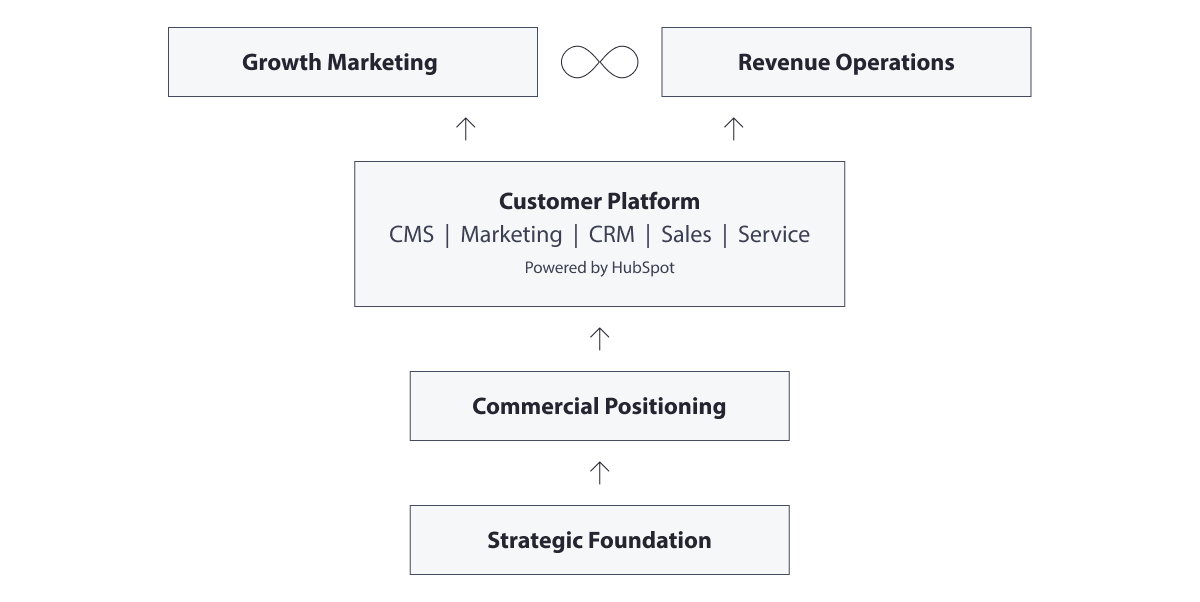
A commercial system is what turns company truth into consistent market expression and more reliable commercial movement. It connects what the business wants to be known for with how it shows up, how opportunities are created, how they move forward, and how decisions are made.
That matters because a front end becomes stronger when its parts stop working in isolation.
Market focus and differentiation need to be clear. The website and digital presence need to support understanding, not just visibility. The way new opportunities are created needs to be deliberate rather than accidental. Sales process and pipeline visibility need to be strong enough to support confidence. And commercial insight needs to help the business see what is actually happening, not just what it hopes is happening.
When those parts connect, the value is practical.
The business becomes clearer about where it wants to win. It becomes more consistent in how it expresses what it does best. Leadership, sales, and marketing are more likely to work from the same understanding. Opportunities are easier to see, define, and progress. Weakness becomes easier to spot earlier.
That is why system design matters. It reduces the amount of work people have to do just to compensate for inconsistency.
7. WHY AI VALUE IS STILL UNEVEN IN MANUFACTURING
AI is attracting serious attention across manufacturing. What remains uneven is value.
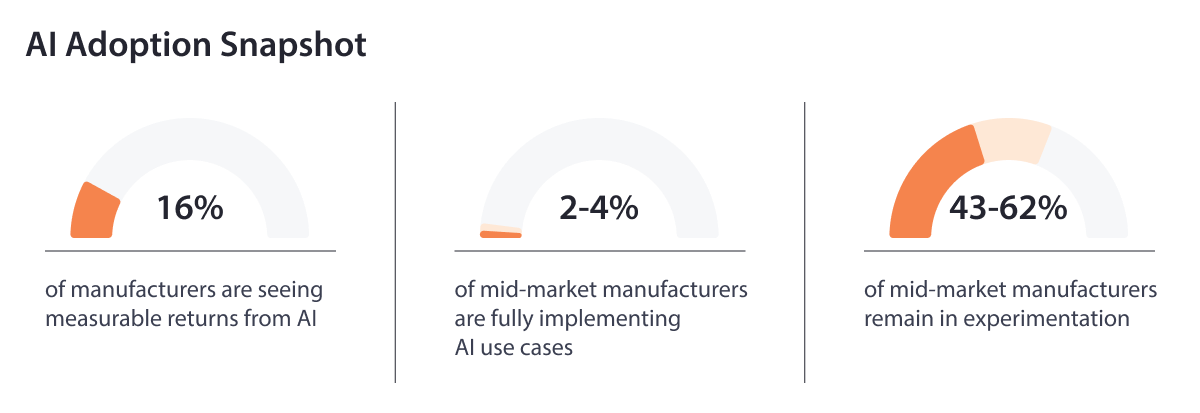
The gap is not interest. It is execution. Recent research from Equinet found that only 16% of manufacturers are currently seeing measurable returns from AI. It also found that many mid-market firms are still stuck in experimentation, while larger manufacturers are much more likely to be implementing AI at scale.
That matters because it changes the question. The issue is not whether AI matters. The issue is whether a business is ready to create useful value from it.
For many manufacturers, the answer is still mixed. Skills gaps, weak data readiness, cultural resistance, and unclear ROI continue to slow progress. Some deployments still create no tangible benefit at all.
This is why the front-office question matters. If the commercial side of the business is still fragmented, adding AI on top of it is unlikely to solve the underlying problem. It may accelerate output. It may produce more analysis. But it will not create clarity where the foundation is still weak.
So the lesson is not to avoid AI. It is to stop expecting AI to compensate for weak design.
8. WHERE AI CAN HELP ONCE THE FOUNDATION EXISTS
AI becomes more useful when it is applied to a commercial side that already has structure, clarity, and feedback.
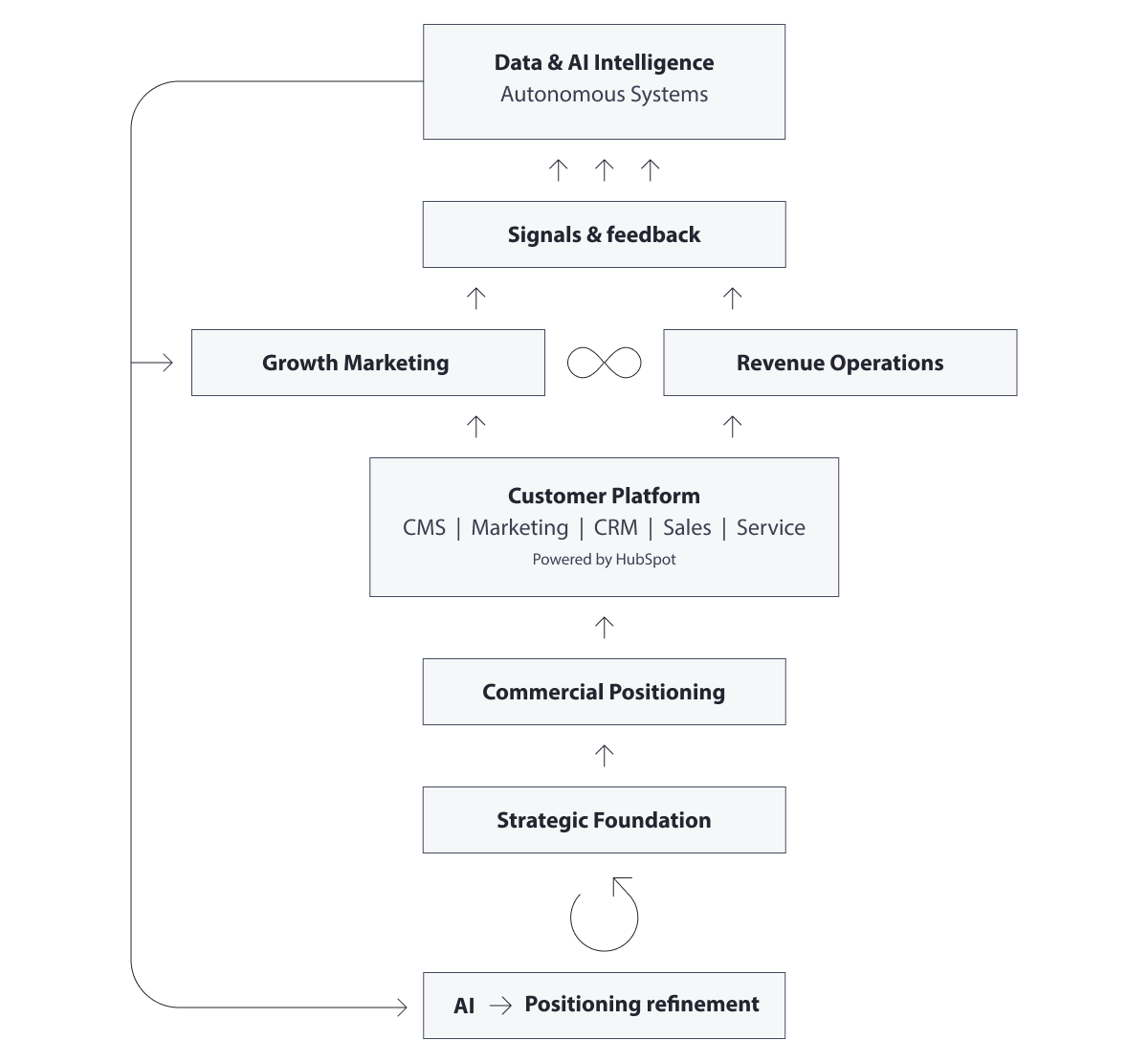
At that point, its role is easier to define. It is not there to invent strategic truth. It is there to help the business interpret signals faster, spot patterns earlier, and refine how the system performs.
That might include identifying where opportunities are coming from, where they are stalling, how buyers are responding, and which messages or activities are driving stronger commercial movement.
But that value still depends on the system underneath. If the business is unclear about where it wants to win, inconsistent in how it defines opportunity, or weak at capturing feedback, AI has little solid ground to work with.
That helps explain why results remain uneven across manufacturing. Interest is high, but measurable value is still limited, especially outside the largest firms.
So the question is not how to apply AI everywhere. It is where a stronger foundation makes a useful application more likely.
That is why the commercial side matters. When it is designed properly, it gives AI something worth refining.
9. WHAT MANUFACTURERS SHOULD DO FIRST
The first step is not a broad transformation project. It is a clearer view of the current commercial side.
That means understanding how the business is showing up today, where confidence is weak, where opportunities are being created, how they move forward, and where visibility breaks down.
It also means testing for alignment. Different teams often see the same commercial reality differently. Leadership may believe the system is clearer than sales experiences it to be. Marketing may see effort where sales sees weak progression. Those gaps matter because they often reveal where the system is least clear.
This is why a diagnostic-led starting point makes sense. Before adding more activity, more tools, or broader change programmes, the business needs to understand what is actually happening now and where the clearest opportunities to improve it may lie.
That first step should stay practical. It should surface where the commercial side is fragmented, where confidence is weak, and which issues appear furthest upstream.
For many manufacturers, that alone is valuable. It creates a clearer shared picture of the current system and a more credible basis for deciding what needs deeper work first.
10. CONCLUSION: FIX THE FRONT END BEFORE YOU TRY TO OPTIMISE IT
When the commercial side is designed properly, the business becomes easier to understand and easier to run.
It becomes clearer where the business creates value. That value is expressed more consistently across the website, sales, marketing, and pipeline processes. Leadership gains better visibility. Teams work from a more shared understanding. Opportunity movement becomes easier to see, assess, and improve.
For contract manufacturers, that matters even more. When the market has less visible proof to work with, the business has to be clearer, more consistent, and more deliberate in how it presents itself.
This is the real opportunity. Not more noise. Not more disconnected activity. A stronger commercial infrastructure.
Get clearer on where the business creates value. Build a commercial front end that clearly and consistently expresses that. Then improve how the business captures feedback, makes decisions, and refines performance.
Only after that does optimisation start to make real sense.
11. NEXT STEP
The most useful next step is to properly investigate the current commercial side.
That means looking at how it is working today, where confidence is weak, where views differ across the business, and where the clearest opportunities to improve it may lie.
A diagnostic-led leadership workshop is one practical way to do that. It helps create a clearer shared picture of the current system and a more credible basis for deciding what needs deeper work first.


We will send a copy direct to your inbox.
Resource Library