
.png?width=16&height=19&name=Icon%20(1).png)


commercial rigour Beyond the shop floor
Why the front office is the last unengineered system in contract manufacturing, and how to build it to the same standard as the plant.

No time to read now?
The system nobody engineered
Contract manufacturers have spent decades engineering certainty into production. Every variable on the plant floor is measured, managed, and improved. The commercial front end never had the same treatment. It accumulated rather than being designed: marketing that runs as a sequence of projects rather than a process, a sales function carried by individual heroics, and a value case that only exists in the heads of a few people who can make it.
Relationships sustained pipelines, referrals filled the calendar, and the shop floor's reputation did the commercial work. That protection is thinning at precisely the moment buyer behaviour has made it most expensive.
Research published in Harvard Business Review by Bain and Google found that 90% of B2B buyers choose from a shortlist they had already formed before formal evaluation began. The research phase is now the decision phase, and increasingly it runs through AI tools that synthesise supplier information rather than browse it.
The cost of a fragmented commercial system isn't hard to find once you know where to look. It shows up in three places: bids lost before you knew they existed, margin surrendered because price was the only argument left, and post-signature leakage nobody could see. All three converge on the number that matters most at the board level: enterprise value.
Adding activity to a fragmented system amplifies the fragments. Treat the commercial operation the way you already treat production: a designed system with documented standards, governed data, quality gates, and a feedback loop that makes it improve with use.
This paper sets out that system: a five-step methodology built specifically for contract manufacturers. Commercial Diagnostic, Commercial Positioning, Commercial Systems, Commercial Data, and Market Amplification. Each step builds on the last, and the whole engine compounds through a Connected Data Loop.
Part 1: The Catalyst
1.1 The precision paradox
Spend a morning on the shop floor of almost any successful contract manufacturer and you'll see disciplined system design everywhere you look. ISO standards. Lean principles. Investment in smart factory technology. Every process repeatable, every output engineered for certainty.
Cross into the front office and that discipline tends to evaporate.
Nobody planned it this way. The commercial side grew piece by piece, each function busy but disconnected from the next. Marketing has its own definition of a good lead; sales has another. Context gets lost every time a prospect moves between teams, so by the time leadership tries to read the pipeline, the picture's already blurred. None of this is down to a lack of effort. People are working hard to compensate for structure that was never built.
The result is a business that performs brilliantly on the factory floor and communicates far less convincingly everywhere else. That imbalance didn't matter much when relationships brought in the work. It's a direct constraint on growth now, because the market that used to reward operational reputation has changed how it buys.
1.2 The market has moved from discovery to pre-selection
The contract manufacturing sector is growing. Precedence Research projects the global Electronics Manufacturing Services market alone will roughly double, from USD 617.9 billion in 2025 to over USD 1.2 trillion by 2035. Across broader contract manufacturing, BCC Research forecasts growth from USD 686.4 billion in 2025 to USD 968.7 billion by 2030, a compound annual growth rate of 7.1%.
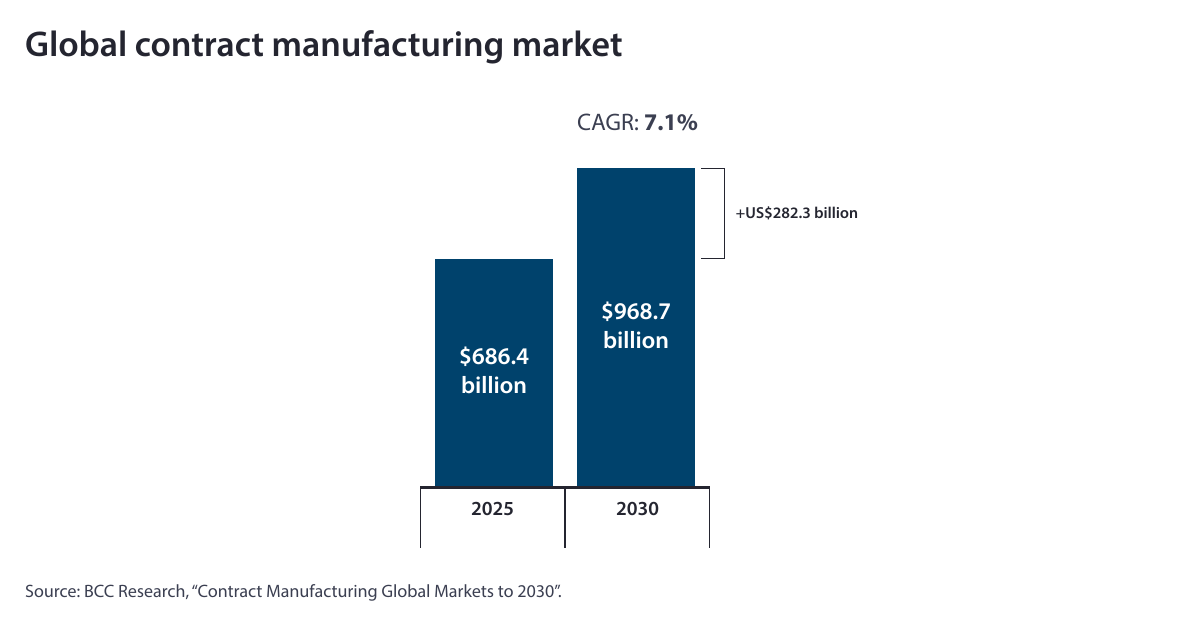
That's sustained structural demand, yes, but it also means a growing pool of broadly capable suppliers holding similar accreditations. The question of how buyers choose between them is becoming more pressing, not less.
And the evidence on how they choose is consistent. Buyers complete roughly 70% of their decision-making before contacting a supplier. In 80% of cases, it's the buyer who makes first contact, not the sales team (Dentsu). Most decisively, 90% of B2B buyers choose a vendor from the shortlist they had in mind before formal evaluation began.
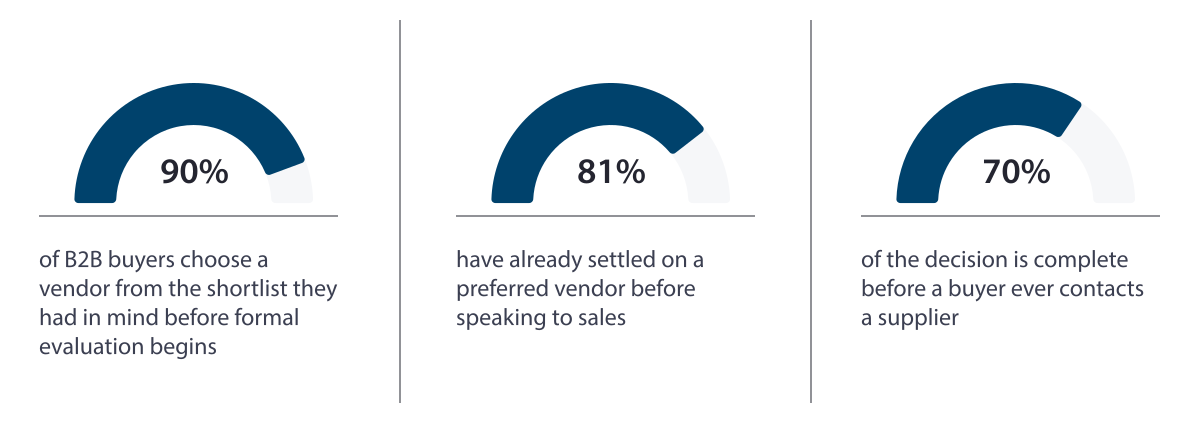
Read that last figure carefully. If the buying group's already decided who it's considering before it speaks to anyone, the commercial conversation is often over before it starts. The decision to consider your business at all was made during the anonymous research phase, based on how clearly and credibly your operation presented itself digitally.
So what are buyers actually optimising for during that phase? The Dentsu B2B Superpowers Index, drawn from more than 16,000 buyer interviews since 2021, has found the same driver at the top of B2B purchasing decisions for three years running: ‘I feel safe signing a contract with them.’ Not price. Not capability claims. Safety. Buyers gravitate toward the supplier who's easiest to evaluate, understand, and trust.
1.3 The commoditisation trap
Put the question to any contract manufacturing leader directly: is your business a commodity supplier? The answer comes back fast and confident – no. Out come the certifications, the tolerances, the cleanroom classifications, the machine lists, decades of programme history.
Then ask why the last three tenders came down to price.
That gap between self-image and outcome is what we call the commoditisation trap: a business that's genuinely differentiated on capability but indistinguishable in how it presents that capability to the market. It takes two things happening at once.
The first is capability convergence. As the sector matures, comparable certifications, comparable capacity, and comparable process standards stop being the exception and become the norm. What was once rare is now table stakes.
The second, and the one you actually control, is sounding like everyone else. When every supplier's website, pitch, and technical documentation reads like a variation on the same asset list, buyers are left with only one variable they can reliably compare: price. Dentsu's research quantifies the drift: 68% of B2B buyers felt the suppliers they considered on a recent purchase all sounded and acted alike, up from 60% just two years before.
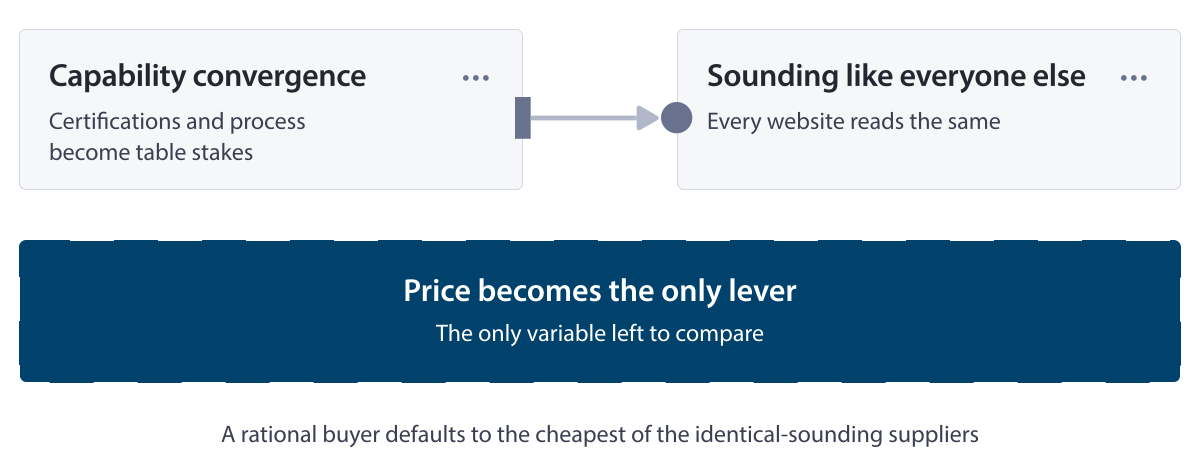
None of this makes the buyer irrational. Faced with five capable suppliers who all look, sound, and read the same, defaulting to the cheapest one is exactly what a rational evaluator does. It's the only decision a buying committee can defend to the board.
There's an objection worth answering directly here: ‘We don't win work through marketing, we win it through relationships and reputation.’ That's been true for decades, and it still carries real weight. But long-standing contacts retire. OEMs consolidate supplier bases and bring procurement into decisions that relationships used to settle. Buying committees now include people in quality, procurement, and finance who've never met you, never visited your facility, and have nothing but your commercial presentation to go on. A strong relationship protects the accounts you already hold; it does nothing for the shortlists forming right now among buyers you've never spoken to.
1.4 The expertise bottleneck
The problem most contract manufacturers face isn't a shortage of capability. The engineering expertise is real. It just doesn't come through in commercial conversations, and there are two structural reasons why.
The first is confidentiality. NDAs and embedded delivery relationships mean the strongest evidence you have – the sophisticated programme, the named customer – is often the one thing you can't share publicly. That's a genuine limitation, but it's also used as an excuse more often than it should be. What it actually rules out is the conventional playbook of client logos and case studies. It doesn't rule out credibility. In a sector where you can't name your proof points, the way you present yourself has to become the proof. Clarity does the job that public evidence usually does.
The second, deeper issue is where the knowledge actually sits. In most contract manufacturing businesses, it lives in a handful of people: the MD who can hold their own with any technical audience, the sales director who knows how to position the business in a bid, the engineers and programme managers who understand, almost instinctively, why customers stay. That knowledge is real and it's valuable, but it's also fragile. It doesn't transfer reliably to a new commercial hire. It doesn't hold its shape as the business expands into new regions or faces different buying committees. And when the people carrying it move on, it goes with them.
Your data has the same fragility. Marketing captures buyer intent signals. Business development captures qualification intelligence and negotiated terms. Account management captures how accounts actually behave after signature. Every function does its job, but the intelligence sits in separate systems, measured against different KPIs, built around different definitions of success. You've built mature systems for managing delivery risk and left fragile ones for managing commercial data risk.
1.5 AI as the accelerant
All of this matters more now because buyer research is shifting shape again. McKinsey research suggests that a growing share of B2B buyers now start their research in AI tools such as ChatGPT or Perplexity rather than a traditional search engine.
These tools don't browse your website the way a person does. They ingest and synthesise. To an AI comparison engine, every supplier looks the same until you give it something to tell you apart. If your documented value doesn't survive that compression, the only cell that differs is price. An unclear value narrative doesn't just lose you the negotiation anymore – it keeps you off the shortlist entirely.
Rushing into AI tooling as the fix deserves the same caution. Equinet's State of AI in Manufacturing report found only 16% of manufacturers are currently seeing measurable returns from AI, and McKinsey reports that a significant share of organisations have experienced negative consequences from generative AI, from accuracy failures to reliability issues. Feed AI a weak commercial foundation and it'll produce shallow, generic content faster than any team could manage on its own. The problem scales with the tool.
The catalyst, then, is a convergence: a growing pool of capable competitors, a buying process that concludes before you're in the room, a differentiation gap you control but haven't closed, knowledge and data that don't scale, and an AI layer that amplifies whichever of those conditions it finds. The next question is what ignoring that convergence actually costs.
Part 2: The Cost of Inaction
The costs of a fragmented commercial system rarely appear as a line item. That's what makes them dangerous. They compound quietly, in four places.
2.1 The margin penalty
Start with the economics of price, because the numbers are stark. McKinsey's pricing research, drawn from across industries, found that a 1% improvement in price realisation translates into an 8.7% rise in operating profit, assuming no loss of volume.
That leverage cuts both ways. A manufacturer pulled into price-based competition isn't just accepting a thinner margin on one deal. Every point conceded for lack of a differentiated case carries an outsized hit to operating profit, often for a discount that isn't even the deciding factor the buyer claims it is.
Bain's 2025 commercial excellence research adds the other half of the picture. Companies confident enough in their positioning to push through price increases achieved a 3-percentage-point profit margin premium over those that weren't. In Bain's framing, that confidence wasn't a personality trait of the sales team. It came from having the commercial intelligence and narrative discipline to justify the price being asked. Manufacturers stuck in the trap aren't short on confidence because their negotiators are weak. They're short on confidence because the underlying commercial system gives them nothing solid to negotiate from.
2.2 The invisible pipeline
The second cost never shows up in the CRM at all, because it happens before the CRM even knows the opportunity exists.
If 90% of buyers choose from a pre-formed shortlist, and 81% have already settled on a preferred vendor before speaking to sales (Dentsu), then your most expensive commercial failures are the evaluations you were never part of. A technical procurement team may have assessed your capability fit, compliance credentials, capacity, and supply-chain resilience, found the picture unclear, and simply moved on. No record. No feedback. Just an absence where a bid should have been.
The greatest commercial inefficiency in the sector sits here – not in the sales process itself, but in the period before it, where most contract manufacturers simply aren't present. Operational strength keeps you competitive once you're in the room. A fragmented commercial system means you might never get in the room at all.
Inconsistency compounds the exclusion. Gartner research found 69% of B2B buyers report finding contradictions between what they read on a supplier's website and what they hear from the salesperson. In a multi-stakeholder decision, contradiction is disqualifying. It hands the buying committee exactly the evidence it needs to stall, or move to a competitor.
2.3 The unseen leak
The third cost shows up only after the contract's won.
Every deal in this sector rests on variables that need tracking for the life of the relationship: committed volumes, price tiers, minimum order quantities, change-control assumptions, renewal dates, account-specific exceptions. Those are the variables that made the original terms defensible. But behaviour against those terms drifts over time, and when the commitments sit in master service agreements and handover notes rather than a live commercial system, nobody sees the drift happening.
The leakage tends to follow a pattern. A client keeps preferential volume pricing long after missing its baseline commitments. A discount agreed for one defined scope quietly survives after the scope has expanded. An account soaks up disproportionate technical, quality, or change-control resource without ever triggering a commercial review. Each of these failures looks small on its own. Run collectively through McKinsey's 1%-to-8.7% leverage, in reverse, they add up to margin erosion that stays invisible until it's already hit the numbers.
2.4 The valuation discount
The first three costs converge on a fourth, and for a Managing Director or CEO, it's the one that matters most: enterprise value.
Put yourself in the position of an acquirer, an incoming PE investor, or your own board reviewing the equity story. What they see in a commercially fragmented manufacturer is a specific pattern of risk: revenue concentrated in a handful of historic accounts, a pipeline nobody can forecast with confidence, commercial knowledge that walks out the door with two or three individuals, and margin variance nobody can fully explain. Each of those knocks a discount into the multiple, whatever the shop floor looks like.
The inverse is just as true. A predictable, diversified pipeline, documented and transferable commercial knowledge, and clean attribution from market activity through to revenue are exactly the characteristics that make a business easier to value, easier to integrate, and safer to buy. Commercial infrastructure isn't a marketing expense; it's balance-sheet work, done through the front office.
2.5 Three questions that reveal whether this applies to you
Before looking at what follows, there's a faster way to find out whether the trap applies to your business.
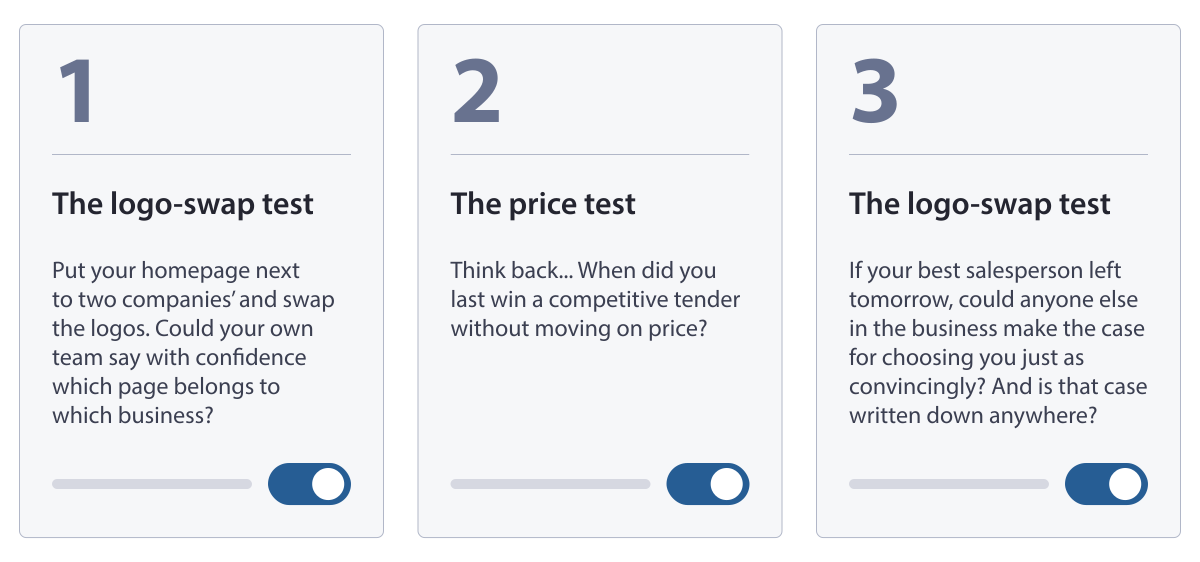
If any of those answers is uncomfortable, the discomfort's data. It tells you the differentiation exists in the business but hasn't been translated into a form the market can perceive. That translation is a job of system design, and it's what the rest of this paper describes.
Part 3: The Commercial Intelligence Engine
3.1 Design principles
The instinctive response to problems like these is to do more: more campaigns, more content, more tools, more outreach. It feels like decisive action. But adding activity to a fragmented system doesn't fix the fragments, it amplifies them. More content produced from unclear positioning just creates more noise. More campaigns without a designed follow-through just create more leads that disappear. Gartner found that 73% of buyers now actively avoid suppliers who bombard them with irrelevant outreach.
The Engine takes the opposite approach, applying to the front office the same logic you already trust on the plant floor:
- Diagnose before you intervene. No prescription without a shared, evidenced baseline.
- Document the standard. Positioning, messaging, and technical narratives verified and written down, not carried around in people's heads.
- Build in quality gates. Human sign-off at every stage where AI or automation acts, functioning exactly like quality control on a line.
- Protect the IP. Commercial systems draw only the operational data they need. Formulations, drawings, and client-owned IP never cross the boundary.
- Close the loop. Market response feeds back into the system, so every cycle sharpens the next one instead of letting the system stagnate.
Five connected steps deliver this, each building on the last. None of it is a software rollout; it's an organisational capability, built with governance at every layer.
3.2 The Engine
Step 1: Commercial Diagnostic
Everything downstream is only as good as the shared diagnosis it starts from. The Commercial Diagnostic is a structured 90-minute workshop that gives leadership teams a clear, common view of how the commercial system is actually performing, and where it could work harder.
Selected stakeholders complete a short pre-work diagnostic to capture perspectives across the team. In the workshop, those responses get analysed live, patterns surface, and the clearest issues get identified together. You leave with a written summary of findings: where confidence in the commercial system is weakest, where views differ across the leadership team, and where the clearest opportunities for improvement lie.
The findings are rarely shocking, and that's not the point. Articulating what everyone half-knows, in one room, with evidence, is what makes commercial progress possible. Where the definition of a good opportunity diverges between teams, where visibility breaks down, where people are compensating for missing structure with personal effort: these answers stop the guessing and give the business a defensible basis for deciding what deserves attention next.
For your leadership team: the Diagnostic surfaces where the CEO, Sales Director, and Marketing Lead see the same business differently. That divergence is usually invisible day-to-day, and it's the root cause of most downstream friction.
Step 2: Commercial Positioning
With a shared baseline in place, the second step turns fragmented technical expertise into a clear market advantage. It is a structured translation of what the business does well into language procurement teams, engineers, and commercial directors can act on.
The distinction that matters here is between a feature and a truth. ‘Five 5-axis CNC machines and an ISO 13485 certified cleanroom’ is a feature: an asset list any competitor with comparable equipment can match, sentence for sentence. ‘The geometric freedom to cut your part count by 30%, lowering assembly cost and removing two field-failure risks’ is a truth. Same equipment, an entirely different value case, and a rate card has no column for it.
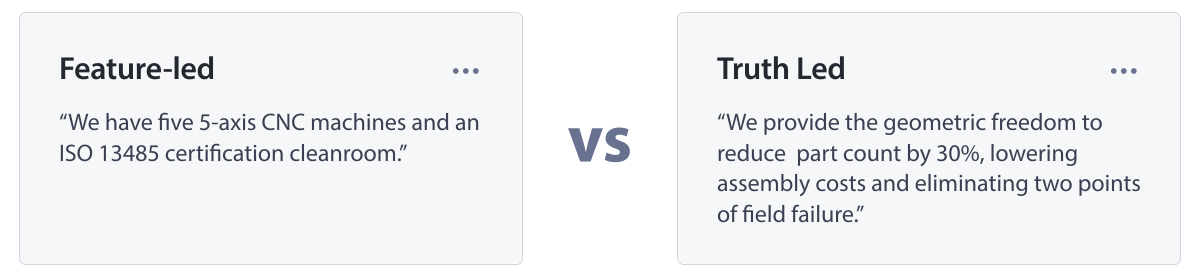
That translation can't be outsourced to a tool. It takes deliberately drawing out what the business does best from the people who actually know – the engineers, programme managers, and quality leads – and turning that into a commercial argument a buying committee can use to justify choosing you.
The work runs through an eight-part process:
- A positioning audit, building on the Diagnostic findings
- Ideal customer definition
- Competitive position analysis
- Positioning strategy
- Value proposition design
- A single commercial narrative
- Sales enablement alignment
- Digital experience alignment
The output is a commercial knowledge system: market clarity, buyer and decision logic, one coherent story, and proof points structured so sales can defend value with confidence. It's the raw material from which everything that follows is built.
For your Sales Director: Commercial Positioning replaces ‘articulate it yourself in every bid’ with documented positioning and proof points that hold up in competitive conversations. The case for choosing you no longer depends on who happens to be in the room.
Step 3: Commercial Systems
Positioning that only lives in a strategy document decays. The third step operationalises it: a governed repository of verified knowledge, standards, and approved messaging, built so AI can generate accurate, verified output at scale without drifting outside what's actually true about the business.
Three components work together.
The knowledge base is a private RAG that holds the verified positioning, specifications, and compliance boundaries from Step 2. Custom LLM agents generate only within those boundaries. The engine is programmatically restricted: it cannot claim what the knowledge base does not support.
The content system scales to every member of the buying committee, so a lean team produces the output of a much larger one.
The orchestration layer connects market data, content operations, and reporting into a single secure, HubSpot-integrated workflow, with human sign-off at every stage.
Governance isn't an afterthought here – it's the whole point. Three lines of human control run through the system. Knowledge Governance is the practice of putting your domain experts, not the AI, in charge of the strategic parameters and final review, so no asset ships unless it's been verified against the knowledge base. Commercial data governance serves as a guardian for the HubSpot Data Hub, enforcing data hygiene and maintaining accurate intent signals. Campaign Operations owns the execution plumbing: workflows, sequences, and attribution.
For the business, the effect is that commercial knowledge no longer depends on individuals. When a senior BD person moves on, the capability stays. When a new region needs onboarding, the standard's already set.
For your Marketing Lead: Commercial Systems eliminates the need to manually tailor high-value messaging for every stakeholder, sector, and persona. It gives a lean team the output of a much larger one, without sacrificing accuracy, and with their judgement as the control point rather than the bottleneck.
Step 4: Commercial Data
The fourth step structures the intelligence that already exists within the business into two halves of a single connected system.
The data foundation maps and targets the accounts worth pursuing. Macroeconomic and market research define the Total Addressable Market. Filtering by geography, industry, and firmographics produces the Serviceable Addressable Market. From there, the Serviceable Obtainable Market narrows to the realistic universe of target accounts, monitored for shifts in research behaviour. Automated enrichment builds comprehensive profiles for every account; signal and intent tracking flags commercial triggers and active decision-makers; qualified leads route straight into HubSpot, structured and scored. That named, scored list is what Market Amplification runs on.
Commercial discipline makes sure the business can deliver, forecast, and report on what those accounts represent. It audits and normalises the commercial datasets feeding forecasts and the CRM. It connects ERP to CRM and factory systems so that sales commitments align with actual production capacity. It standardises the deal process for high-stakes, multi-stakeholder RFQs, with Go/No-Go criteria, stage definitions, and clear ownership. And it tracks post-contract performance, so expansion opportunities get spotted and margin drift is caught while there is still room to act.
A word on the ERP CRM connection, because it is where operations leaders rightly push back. Production systems hold customer IP, proprietary formulations, drawings, process parameters, and regulated quality data. That environment should not be open to the commercial side of the business, and in this architecture, it is not.
The commercial system receives only the operational data it needs to monitor commercial commitments: customer identifier, contract reference, SKU or project code, shipped units, delivery status, and agreed thresholds. Enough verified data to protect margin. Nothing that exposes what the customer owns or what the production floor depends on.
For your Operations Director: the integration is one-way and tightly scoped. Commercial teams get a clean read on whether accounts are behaving as agreed. Formulations, drawings, and batch records never cross the boundary.
For your CFO: this is where the McKinsey leverage becomes actionable. Volume commitments, price tiers, and contract terms stay live and visible, so pricing conversations happen when they are warranted and are backed by data when they do.
Step 5: Market Amplification
Only once positioning's documented, knowledge's governed, and data's structured does the engine start to amplify. That ordering is deliberate: amplifying before the foundations are right just means producing more inconsistency, faster and at greater volume.
Given that most of the buying journey occurs before a buyer ever engages sales, amplification must reach buyers before that first contact, not after. The engine runs account-based campaigns at three levels of intensity, matched to where each account sits in its buying cycle:
- One-to-many: broad, inbound-style campaigns that attract interest across the target market, generating awareness, capturing early signals, and identifying potential accounts.
- One-to-a-few: focused campaigns tailored to defined groups of high-value accounts, combining personalisation with automation.
- One-to-one: highly personalised, account-specific campaigns developed in close alignment with sales, reserved for the most valuable commercial opportunities.
Accounts move between tiers based on the signals and scoring from Step 4, not on gut feel. The whole model runs on Loop Marketing in HubSpot – HubSpot's framework for running continuous, signal-driven campaigns rather than one-off bursts, so engagement data constantly refines who gets targeted and how. It's data-led, so campaigns are built on a clear view of account activity and intent; automated, so personalisation scales without manual overhead; and accountable, with full-funnel reporting tier by tier.
Alongside the campaigns, Answer Engine Optimisation (AEO) keeps the business accurately represented in AI-assisted procurement research.
For your Sales Director: one-to-one campaigns get built with sales, not thrown over the wall. Signal alerts feed directly into the account executive queue, so outreach lands within 24 to 48 hours of a trigger, rather than weeks after the moment has passed.
3.3 The Connected Data Loop
What separates an engine from a collection of activities is feedback. As target accounts engage with deployed content, HubSpot logs that behaviour and streams it back into the Private RAG. The core positioning stays untouched, but the system gets sharper with every cycle.
The loop closes at the top, too. Amplification results and commercial dashboards feed a periodic re-run of the Diagnostic, so the leadership baseline gets refreshed with evidence rather than impressions. The strategic foundation makes the positioning credible; the positioning makes the digital presence coherent; the presence supports sales; sales feeds the pipeline; the pipeline generates signals; and the signals refine the foundation. Because it's built to learn from itself, the system becomes more valuable the longer it runs, rather than losing relevance as a one-off campaign does. That's the difference between smart commercial infrastructure and marketing spend.
Part 4: The Enterprise Value
What does the business look like once the engine is operational? Four dividends, each of which reads directly onto the metrics a board cares about.
4.1 A pipeline you can plan capacity against
The most immediate change is predictability. A structured SOM, monitored for intent, feeding scored accounts into tiered campaigns, produces a pipeline built on evidence rather than heroics. That does more than reassure the sales forecast. In a business where the factory needs filling with high-fit, high-margin work, pipeline predictability is capacity planning. It's the difference between quoting just to keep the lines warm and choosing the work the plant was actually built to win.
4.2 Margin defence and pricing confidence
The engine attacks margin from both ends. Upstream, a translated value narrative gives buyers a basis for decision other than price. That's what escaping the commoditisation trap actually means: not winning the price argument, but removing the conditions that made price the only argument available. Downstream, live visibility of commitments and account behaviour stops the quiet leak. Bain's 3-point margin premium belongs to businesses with the commercial intelligence to know when a pricing conversation is warranted, and the data to back it up when it happens. That intelligence is exactly what Steps 2 through 4 build into the business.
4.3 Commercial knowledge that survives people
For the owner-managed business, that's legacy work: decades of intuition captured in a form a successor, a management team, or the next generation can actually run with. For the professionally managed mid-market firm on an investor clock, it's de-risking: a repeatable commercial model that replaces founder-dependent habits and holds up under due diligence. For the global group, it's consistency: one standard deployed across regions and plants, regardless of whether the local team happens to include a gifted communicator.
In all three cases, the underlying asset is the same. The positioning's documented. The technical narratives are verified. The knowledge from engineering, quality, and operations is structured and deployable. Commercial capability belongs to the business, not to individuals within it, and an acquirer can see that it does.
4.4 Board-ready visibility
Finally, the engine makes the commercial operation reportable: full-funnel attribution, tier by tier; forecasting built on clean, normalised data; variance analysis that surfaces commercial risk before it reaches the bottom line. For the leadership team, this ends the era of walking into board meetings with a pipeline number nobody quite trusts. Growth becomes something you can evidence: structured, sustainable, and visible.
The contract manufacturers that win the next decade won't simply be the most operationally excellent. They'll be the ones who are also the most commercially legible. Operational excellence gets you considered once you're in the room. Commercial infrastructure is what gets you into the room.
Where to start
You've already proved that disciplined systems produce reliable results. On the plant floor, nothing critical gets lost because the system's designed to prevent it. The same logic, applied to the commercial front end, is what makes growth as predictable as your production line.
The sensible first move isn't a transformation programme. It's a diagnosis.
The Commercial Diagnostic is a 90-minute workshop that gives your leadership team a clear, shared view of how your commercial system is actually performing: where confidence is weakest, where views differ across the team, and where the clearest opportunities lie.
Most leadership teams find it clarifying, not because the findings are surprising, but because articulating what everyone already knows together, with evidence, is where commercial progress starts.


We will send it to your inbox.
Resource Library