

A Front Office
Conundrum
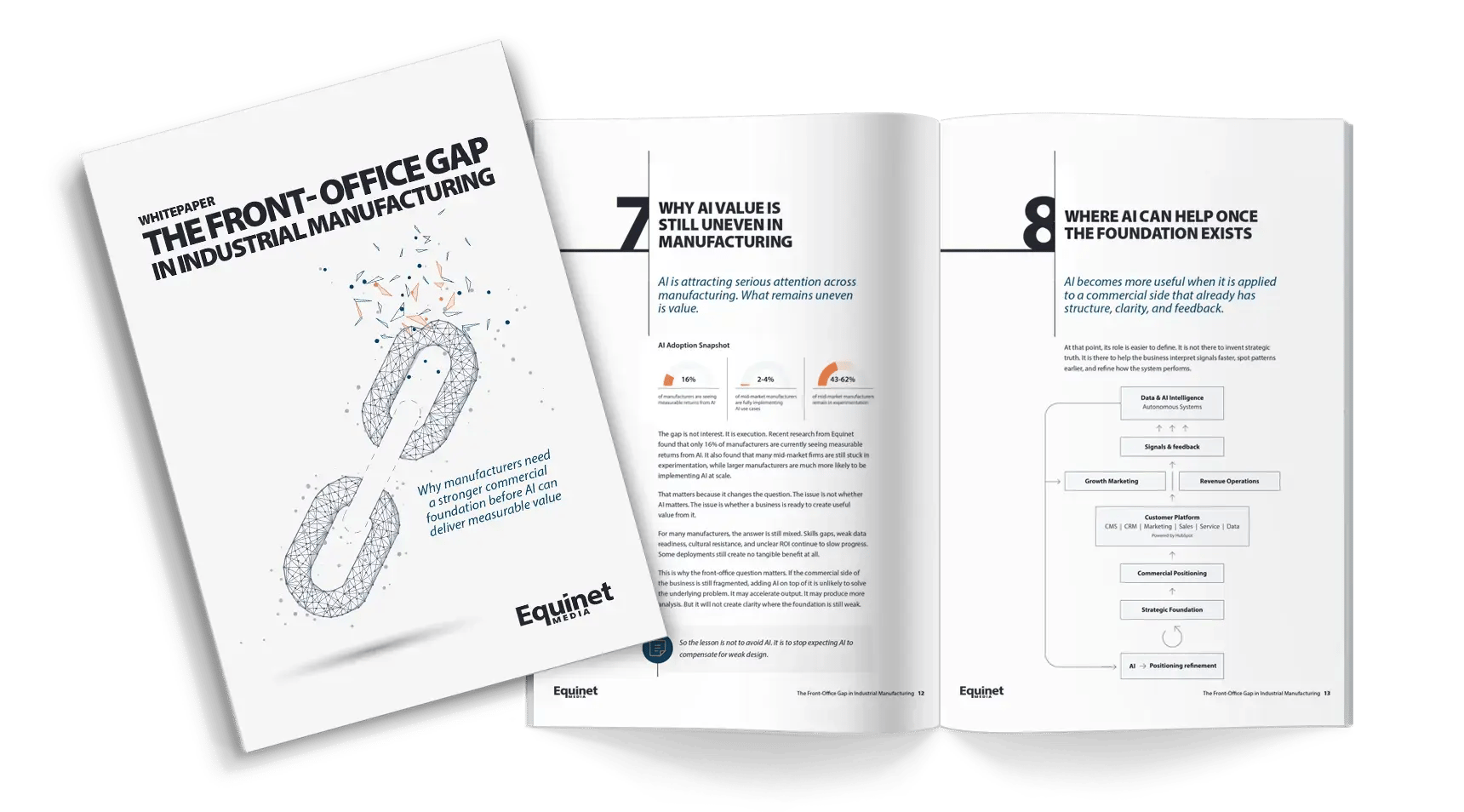
Why contract manufacturers need a stronger commercial foundation before AI can deliver measurable value
No time to read now?
The conundrum
Many manufacturers have already made AI work on the line. Vision systems catch defects a tired inspector would miss. Models flag a failing spindle before it stops a cell. Scheduling tools absorb a late component faster than any planner could. The gains are measurable because the line was built to measure them.
Then the same leadership team turns to the front office. AI drafts proposals, scores inbound enquiries, summarises calls, and forecasts the pipeline. The output arrives quickly and in volume. The value is much harder to point to. Proposals read fluently and say little a competitor couldn't also say. Lead scores sit unused because sales doesn't trust them. Forecasts move with whoever last updated the record.
Same business. Same leadership. Often the same software vendors. A very different result.
The evidence suggests this is common. Equinet's State of AI in Manufacturing report found that only 16% of manufacturers are currently seeing measurable returns from AI. Across industries, Gartner found that 63% of organisations either lack or are unsure they have the data management practices AI needs. It predicted that by 2026, organisations would abandon 60% of AI projects that lacked AI-ready data.
AI now ships inside the CRM, email and document tools commercial teams already use. It is reaching the front office whether or not anyone has planned for it. What matters is what it finds when it gets there.
Other papers in this series look at how buyers use AI to research and compare suppliers. This one looks at the other side. It asks what happens when a contract manufacturer puts AI to work in its own front office, why the results lag the shop floor, and what has to be in place first.
Why AI found the shop floor first
Equinet's report observed that AI momentum in manufacturing is strongest where decisions are frequent, measurable and repeatable. That describes the production line, and it is no accident. Decades of quality and process discipline created the conditions a model needs, long before anyone had a model to run.
Five conditions do most of the work.
A specification. Every part has a drawing and a tolerance. Good is defined before the first piece is made, so a model has a target to work towards.
Consistent data. Machines, MES, and SPC record what happens in the same format as it happens.
Volume. A line runs thousands of cycles a shift. That is enough outcomes for a model to learn which patterns matter.
A closed loop. A defect is found, traced to its cause, corrected, and the correction is recorded.
Controls. Nothing reaches a customer without passing inspection. If an AI recommendation is wrong, the quality system catches it.
ISO standards, lean, and statistical process control were developed for certainty long before AI existed. They turned out to be the foundation it needed. The shop floor was ready for AI before AI arrived.
What the front office gives AI to work with
Run the same five conditions through the front office, and the gap becomes specific.
A specification. Is there a written, agreed-upon definition of a good-fit opportunity? Is there a verified account of what the business does best and for whom? In most front offices, that knowledge sits in the judgement of a few experienced people. Ask an AI to find good-fit accounts or write a winning proposal, and it has no drawing to work with. So it works to the average of everything it has read.
Consistent data. Different people use CRM fields differently. Deal stages mean one thing to marketing and another to sales. Records are complete when someone has time to complete them. A model reads all of it as equally true.
Volume. This condition matters most and gets discussed least. A production line makes thousands of decisions a shift. A contract manufacturer may make only a few dozen significant commercial decisions in a year: which RFQs to bid, how to price them, which programmes to pursue. The outcome of each can arrive many months after the decision that shaped it. No model learns much from so few results arriving so late.
A closed loop. When a bid is lost, the reason is often recorded in a single word, if it is recorded at all. Without honest outcome data, the system has nothing to learn from. The next proposal gets no guidance on what to do differently.
Controls. On the line, nothing ships unchecked. In the front office, an AI-drafted email can reach a buyer without anyone checking its claims against what the business can actually deliver.
That is the conundrum in full. The front office was never engineered to provide the conditions the shop floor provides as a matter of course, so AI arrives with nothing firm to work from. The plant shows what is missing and what the fix looks like.
Where AI stalls in the front office
The pattern repeats across the uses leadership teams reach for first. Each one stalls on a specific missing condition.
Content generation
AI produces fluent capability statements, emails and proposal sections at speed. Without a verified source of what is true about the business, it fills the gaps in one of two ways. It uses the language every supplier uses, or it makes plausible claims nobody has checked. More content arrives, and very little of it could only have come from you.
Missing condition: the specification
Lead and account scoring
A scoring model needs a definition of what good looks like and enough outcomes to calibrate against. Give it an informal definition and a few dozen wins a year, and it produces numbers that look precise and change nothing. Sales sees the misses and stops looking.
Missing conditions: the specification and enough signal
Forecasting
An AI forecast is only as good as the stage data underneath it. When stages are applied inconsistently, the model reports the optimism of whoever updated the record last, just faster and with more decimal places.
Missing condition: consistent data
Sales assistants
Call summaries, account briefs and next-best-action prompts depend on a complete account history. When half of that history sits in inboxes and people's heads, the experienced rep knows more than the tool. The tool quietly falls out of use.
Missing condition: the closed loop
In each case the instinct is to blame the tool and try another. The replacement meets the same gaps and stalls in the same place.
A claim is a controlled statement
There is a further reason the front office needs care, and it is particular to contract manufacturing.
In medical devices, aerospace, defence, and pharmaceuticals, what a business says about its capabilities is regulated. Accreditation scopes, cleanroom classifications, validated processes and tolerance capabilities are statements the quality system stands behind. A sales document that overstates any of them can create a commitment the plant must honour or an expectation the business cannot meet.
Generative AI is built to produce plausible text, but plausibility and verifiability are different properties. When asked to describe your capabilities, a model will readily round a tolerance or extend a certification to a site it doesn't cover. It may also describe a process qualified on one product line as if it applied to all of them.
In a contract manufacturer, governing AI output in the front office is therefore a quality matter. The business already knows how to do it. Controlled documents, approved sources, and defined authority to sign off provide the quality system with its template. Applied to the front office, that means AI generates only from verified facts, and a person who knows checks the output before it reaches a buyer.
What an AI-ready front office looks like
The answer follows directly from the plant. Each of the five conditions has a front office equivalent.
A specification: a documented, verified account of what the business does best and for which buyers. It also sets out how to tell a good-fit opportunity from a poor one. It is written down and used by both systems and people.
Consistent data: one place where commercial activity is recorded, with definitions that everyone applies the same way.
Enough signal: the intermediate evidence captured alongside the outcomes. That means engagement, qualification answers, stage movement, and the real reasons bids are won and lost. With few outcomes a year, this evidence is what gives a system enough to learn from.
A closed loop: results flowing back to refine the definitions, messaging, and targeting, so each cycle improves the next.
Controls: human sign-off wherever AI output reaches a buyer, and a firm boundary on what the commercial side can see. Customer IP and production data stay where they belong.
None of this is exotic. It is the discipline the business already applies on the line, pointed at the front office.
With it in place, AI's role becomes easy to define. It drafts from verified material instead of guessing. It reads engagement and stage data to show where opportunities are moving and where they are stalling. It flags accounts drifting from what was agreed. It also frees experienced people from having to rebuild the same material for every bid. Each of those is useful, and all of them depend on the foundation underneath.
Five questions before the next AI pilot
Before adding another AI tool to the front office, five questions give a quick read on whether it has anything firm to work from.
- Is there a written definition of a good-fit opportunity, and does the CRM use it?
- If an AI read your website, capability statement and last five proposals, would it come away with an accurate and specific account of what you do best?
- Do your CRM records mean the same thing to whoever entered them?
- When you lose a bid, do you record why in a form so you can analyse it a year later?
- Before AI-generated material reaches a buyer, who checks it against what the plant can actually deliver?
Where the answers are mostly yes, AI has a foundation to refine, and a focused pilot is likely to yield measurable results. Where they are mostly no, the next investment that pays is in the foundation. A pilot built on top of it would mostly measure the gaps.
Where to start
You already know how to make AI work, and the shop floor proves it. The task now is to give the front office what the plant has had for years: a specification, consistent data, enough signal, a feedback loop and controls.
The sensible first step is an evidence-based view of where the front office stands today. The Commercial Diagnostic gives your leadership team that view. It shows where the commercial system is strong, where it is fragmented, and which gaps sit furthest upstream, before any further investment in tools.
Further reading: Beyond the Shop Floor for the full methodology, and The Leadership Perception Gap for why leadership teams see the same commercial system differently.

We will send a copy direct to your inbox.
Resource Library