
.png?width=16&height=19&name=Icon%20(1).png)


The cost of
a hidden expertise bottleneck
How disconnected commercial data is eroding margin and pipeline for contract manufacturers

No time to read now?
The data nobody connects
Most contract manufacturers hold more commercial intelligence than they realise. It exists in the notes from a qualification call, in the context a Business Development manager carries after months of relationship-building, and in the buyer intent signals sitting in a marketing platform that the sales team rarely gets to see. This knowledge shapes which opportunities get pursued, how contracts get structured, and whether accounts ultimately become profitable. But it doesn't always reach the people who need it. And that gap has a cost that's easy to miss until it shows up in the numbers.
The reason is structural. Marketing, Business Development, and Account Management each run on different systems, measure against different KPIs, and capture data in formats the next team can't always use. The result is that valuable commercial intelligence often doesn't reach the people who need it most. This article explores why that matters more than most contract manufacturers expect, and what a more connected approach looks like.
Where the data stops flowing
Every team is capturing something useful. But it's rarely structured in a way that the next team can readily use.
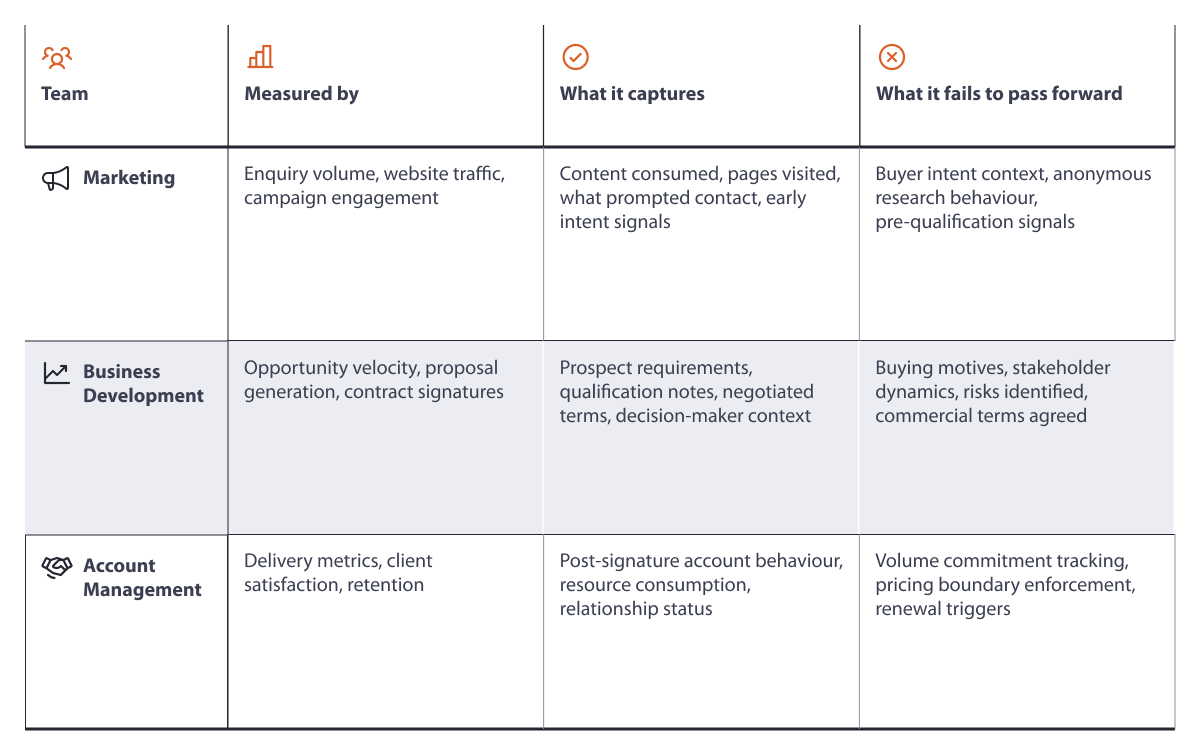
Your Marketing team is measured by inquiry volume, website traffic, and campaign engagement. It captures what content a prospect consumed, which pages they visited, and what prompted them to make contact.
Your Business Development team is measured by opportunity velocity, proposal generation, and contract signatures. It captures what a prospect said during qualification, what requirements they stated, and what terms were ultimately agreed.
Your Account Management team is measured by delivery metrics, client satisfaction, and retention. It captures how an account has behaved since signature — what changed, what consumed more resource than expected, and where the relationship stands today.
Each team is doing its job. The problem is that the intelligence each team generates lives in separate systems, structured around its own KPIs rather than the needs of the next handover.
Buyer intent signals captured by Marketing aren't structured around the qualification criteria Business Development needs. And terms negotiated by Business Development aren't visible to the Account Management team responsible for enforcing them.
The business has mature systems for managing delivery risk. But fragile systems for managing commercial data risk. And in a sector where the buying journey is long, technically complex, and involves multiple stakeholders, those handover losses can accumulate into a serious commercial liability.
Closing that gap requires more than new systems. The harder work is cultural: getting Marketing, Business Development, and Account Management to agree on what good looks like, share ownership of commercial data, and build the habits that keep intelligence flowing between teams.
The buyer is already ahead of the seller
This data governance failure matters more now because of how buyer behaviour has shifted:
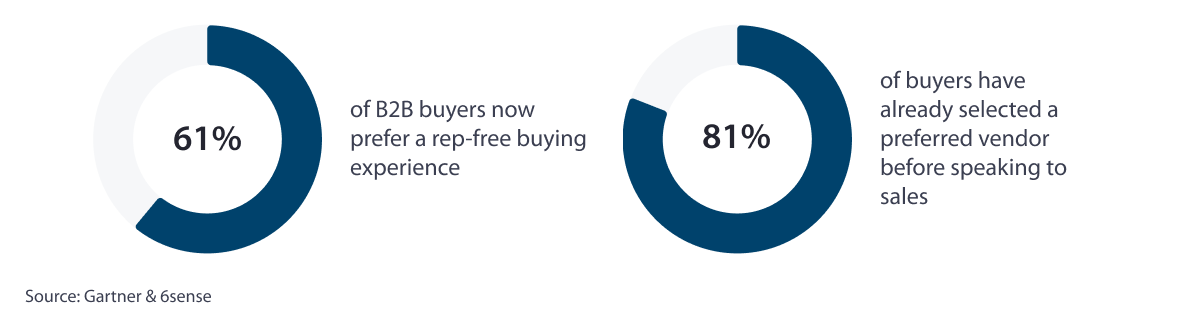
These figures come from broader B2B research, but it’s consistent with what's happening across contract manufacturing.
It doesn't mean decisions are final before sales engagement, but it does mean preferences are forming, requirements are hardening, and shortlists are narrowing, often before your Business Development team is even aware of the opportunity.
Before making contact, a technical procurement team may already have assessed your capability fit, compliance credentials, modality expertise, geographic footprint, capacity, and supply-chain resilience. Anonymous research has become a decision phase, not a discovery one.
The intelligence your Marketing team captures during that anonymous phase is the most commercially valuable data in your funnel. It reveals what a buyer was looking for before they decided to engage. It shapes how Business Development should approach the first conversation. But few contract manufacturers have a structured way to use it.
If Marketing captures early digital intent signals but has no structured way to pass that context to Business Development, your commercial team enters the initial conversation blind. They're qualifying an opportunity without knowing what the buyer already knows, which competitors they've already evaluated, or how far along their decision process they actually are.
The quiet cost of disconnected data
The data failures described above don't just affect pipeline and qualification. The cost shows up further downstream, in your margins.
Your contracts are built on dynamic variables that must be tracked over the lifetime of a relationship: committed volume, price tiers, minimum order quantities, change-control assumptions, renewal dates, validation scope, and account-specific exceptions.
Those variables are what made the original commercial terms defensible. The terms themselves are agreed at signature.
But customer behaviour against those terms can drift, and when nobody has visibility of that drift, margin leaks quietly and persistently.
When those commitments live in master service agreements, statements of work, tech transfer documents, or handover notes rather than an active commercial system, your Account Management team can't reliably track them. The leakage takes predictable forms:
- A client continues receiving preferential volume pricing after missing its baseline commitments
- A discount agreed for one defined scope persists after the scope expands
- An account absorbs disproportionate technical, quality, or change-control resource without triggering a commercial review
Each of these failures is individually small. Collectively, they add up.
McKinsey's pricing research, drawn from across industries, shows that a 1% price optimisation translates into an 8.7% increase in operating profits, assuming no loss of volume.
The leverage principle applies directly to contract manufacturing, where pricing is often tied to volume assumptions that drift over time. Small, persistent failures in price discipline, discount control, and volume-tier enforcement carry the same outsized penalty in the opposite direction.
Bain's 2025 commercial excellence research (drawn from a global study of B2B companies across manufacturing, technology, and professional services) identifies insufficient data analytics as a direct barrier to margin-enhancing pricing decisions. The research also found that companies confident in executing price increases achieved a 3 percentage-point profit margin premium over those that were not.
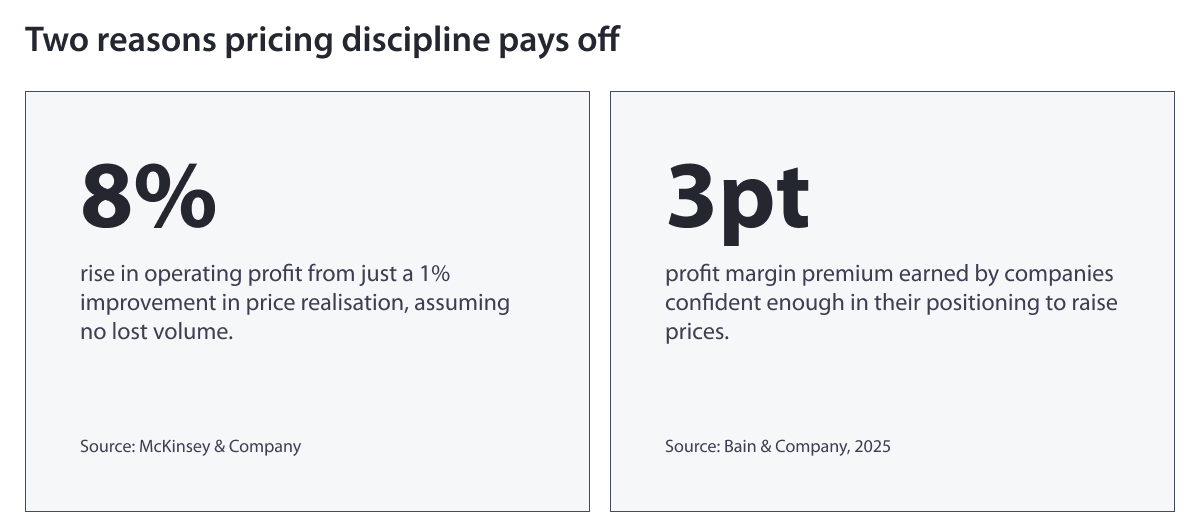
The businesses with that confidence share a common characteristic. They have the account-level commercial intelligence to know when a pricing conversation is warranted and the data to support it when the conversation happens. Without it, margin erosion happens quietly, and often goes undetected until it shows up in the numbers.
Fixing the data flow
Commercial intelligence breaks down at the handover points between teams. Fixing that means being deliberate about what gets captured, how it gets passed on, and what stays visible after a contract is signed.
1. Centralise your commercial data
Buyer intelligence, inquiry data, opportunity notes, proposal assumptions, contract terms, and account activity shouldn't be scattered across spreadsheets, inboxes, and disconnected platforms. It all belongs in one system. For many mid-market contract manufacturers, HubSpot is the platform that makes this possible, connecting marketing, sales, and account data in one place.
That system should hold everything your organisation knows about every prospect and customer: what they were looking for, what was said during qualification, what was negotiated, what was agreed, and how the account has behaved since.
2. Standardise what Marketing passes to Business Development
Marketing should capture more than a name, an email address, and a form submission. It should capture the technical and commercial parameters Business Development needs to assess whether an opportunity is worth pursuing.
For a CDMO or CMO, that means information such as molecule type, development phase, GMP requirements, regulatory geography, batch size, and tech-transfer complexity. For an EMS or CEM provider, it means industry segment, compliance requirements, build complexity, product lifecycle stage, and expected production volumes.
In practice, a structured Marketing to Business Development handover might look like this: a completed lead profile capturing the prospect's sector, compliance requirements, product lifecycle stage, expected volumes, and any technical constraints flagged during the anonymous research phase, passed automatically into the CRM at the point of qualification. Marketing owns the capture. Business Development owns the qualification. The system connects them.
This isn't a one-way transfer. When Marketing captures structured intent data before the first conversation, Business Development gets something it rarely has: context. Which capabilities the buyer was assessing, which compliance requirements they were researching, and how long they spent evaluating before making contact.
That intelligence doesn't just make qualification faster. It changes the quality of the first conversation. Your Business Development team enters the conversation already knowing what matters to the buyer, rather than spending the first call finding out.
3. Keep what Business Development knows visible to Account Management
When a contract is signed, the intelligence Business Development gathered during the sales process shouldn't disappear with it. Buying motives, stakeholder dynamics, decision criteria, service expectations, and risks identified during qualification are exactly what Account Management needs to manage the relationship well. That context should be passed on deliberately, not left to memory or a handover call.
The same applies to the commercial terms themselves. Volume commitments, pricing boundaries, renewal dates, and change-control triggers need to stay live and visible. When Account Management can see the assumptions behind a contract, they can act when those assumptions stop holding, before margin slips away.
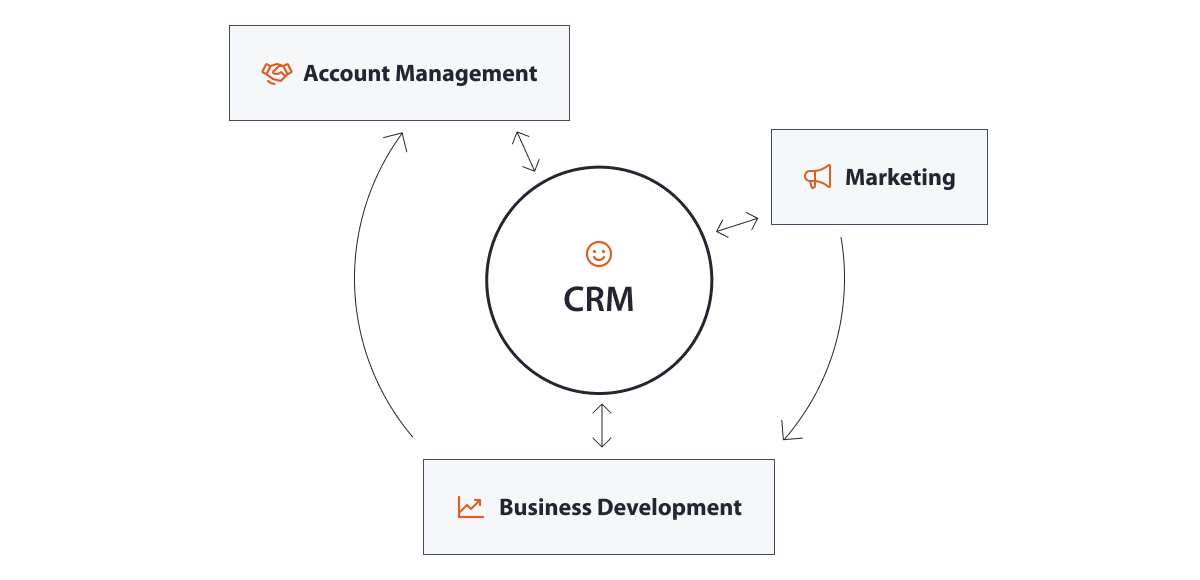
None of this requires a lengthy transformation programme. A structured lead handover framework can be defined and live within a few weeks. CRM configuration follows. By the end of a quarter, the data flow between Marketing, Business Development, and Account Management is operational. Not perfect, but working.
How far should commercial data reach?
Once commercial data flows properly between your internal teams, the natural question follows: should it connect to production data too?
The most complete picture of an account comes from knowing not just what was agreed, but whether it's actually happening.
Is the customer meeting the volume they committed to? Is the account consuming more resource than the original agreement assumed?
That kind of visibility would give Account Management a much sharper picture.
For businesses operating across multiple sites or regions, this question carries additional weight. Commercial commitments may vary by plant, by geography, or by customer agreement. A centralised commercial intelligence layer needs to account for that complexity, with appropriate governance to ensure regional data is captured consistently without creating new silos at a local level.
But contract manufacturers are rightly protective of their production systems. They may contain client IP, proprietary formulations, technical drawings, process parameters, batch records, and regulated quality data. That environment shouldn't be open to the commercial side of the business.
The appropriate model gives your commercial teams a clean read on what's happening in your accounts, without exposing your production floor.
The commercial system receives only the operational data needed to monitor commercial commitments: customer identifier, contract reference, SKU or project code, shipped units, batch count, delivery status, and agreed commercial thresholds. It doesn't expose formulations, process instructions, technical drawings, batch records, or any client-owned IP.
Enough verified operational data to protect margin and monitor commitments. Nothing that exposes what the client owns or the production floor depends on.
You already have the blueprint
You've already proved that disciplined systems produce reliable results. On the production floor, nothing critical gets lost because the system is designed to prevent it.
That same discipline, applied to commercial data, is what makes commercial growth as reliable as your production line. Buyer preferences form early. Pricing discipline compounds. Commercial intelligence is a margin-protection discipline.
The contract manufacturers that get this right will grow more predictably. The ones that don't will keep absorbing costs they can't clearly see.
If this has prompted you to think differently about how commercial intelligence flows through your business, the Commercial Diagnostic is designed to give your leadership team an independent picture of where things stand. Where intelligence is getting lost, where your account visibility is weakest, and what a more disciplined approach to commercial data could look like for you.


We will send it to your inbox.
Resource Library