
.png?width=16&height=19&name=Icon%20(1).png)


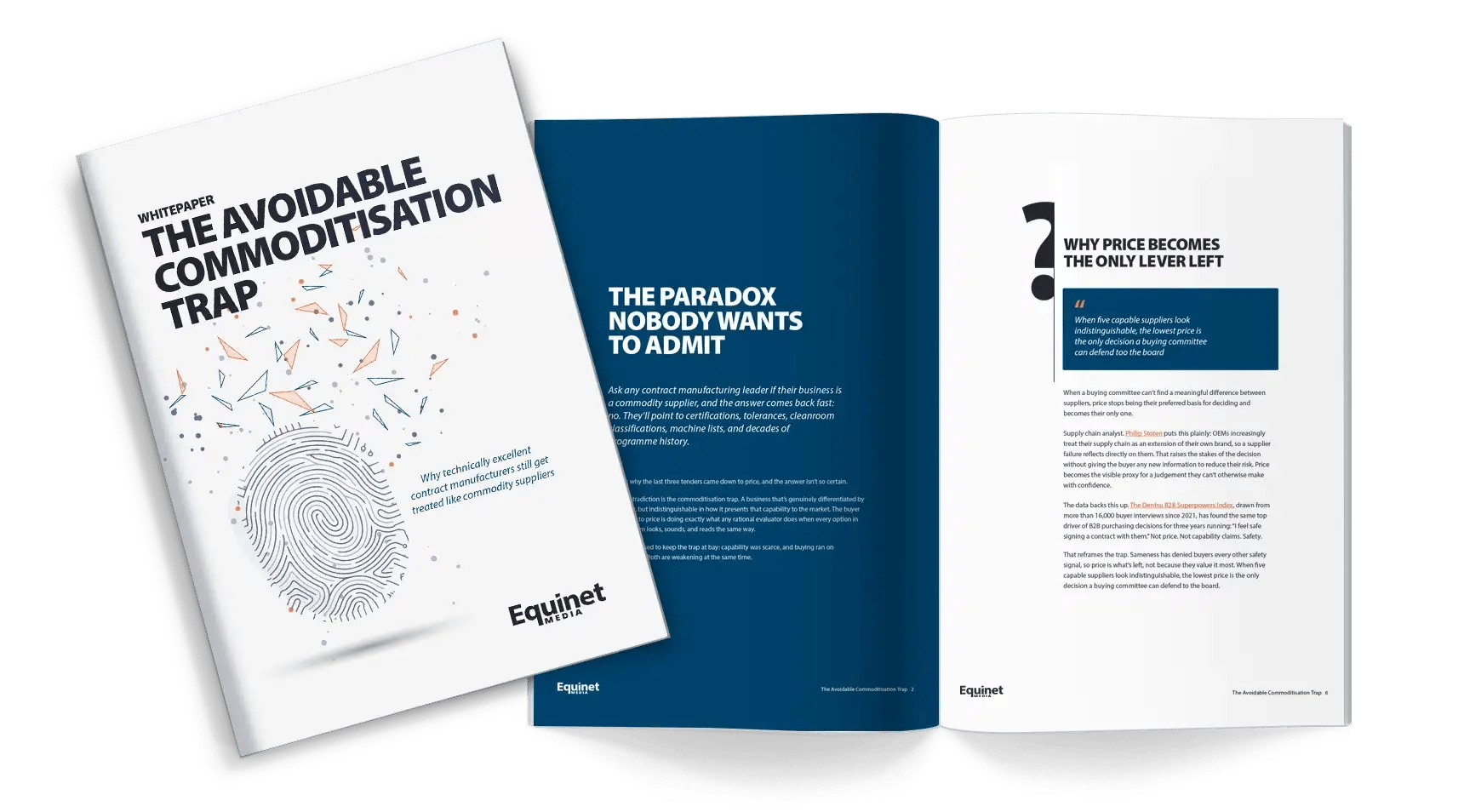
The avoidable commoditisation trap
Why technically excellent contract manufacturers still get treated like commodity suppliers

No time to read now?
The paradox nobody wants to admit
Ask any contract manufacturing leader if their business is a commodity supplier, and the answer comes back fast: no. They'll point to certifications, tolerances, cleanroom classifications, machine lists, and decades of programme history.
But ask why the last three tenders came down to price, and the answer isn't so certain.
That contradiction is the commoditisation trap. A business that's genuinely differentiated by capability, but indistinguishable in how it presents that capability to the market. The buyer defaulting to price is doing exactly what any rational evaluator does when every option in front of them looks, sounds, and reads the same way.
Two things used to keep the trap at bay: capability was scarce, and buying ran on relationships. Both are weakening at the same time.
What is the commoditisation trap?
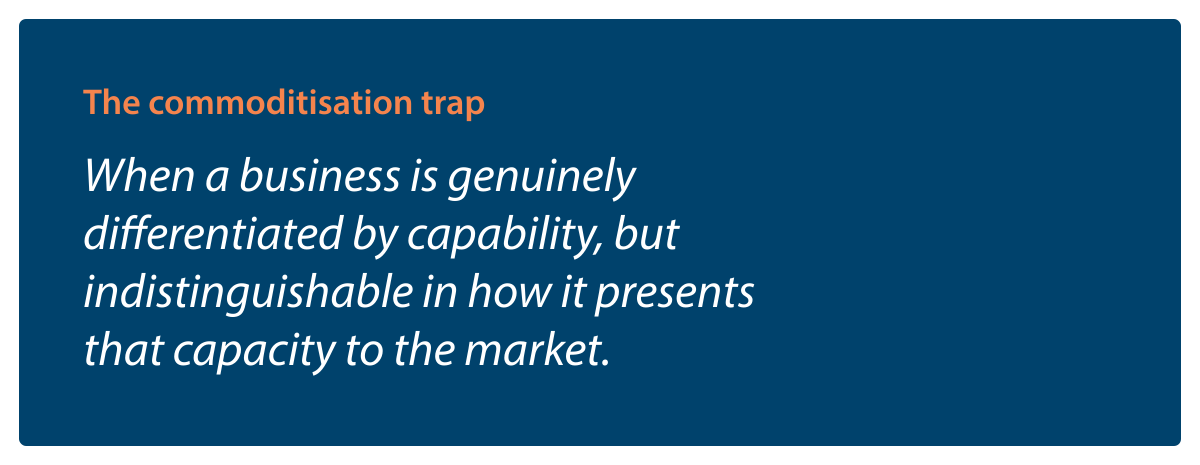
The commoditisation trap happens in the buyer's mind, the moment they can't find a reason to tell one supplier from another. It's a perception problem, and it starts long before price is on the table.
Two things create it, and you need both for it to take hold.
The first is that capability across the sector keeps catching up. As it matures, comparable certifications, comparable capacity, and comparable process standards become the norm rather than the exception. BCC Research projects the global contract manufacturing market to grow from $686.4 billion in 2025 to $968.7 billion by 2030, a CAGR of 7.1%. Within that, Precedence Research expects the electronic manufacturing services market alone to more than double, from $617.9 billion in 2025 to over $1.2 trillion by 2035.
That scale brings more credible suppliers holding similar accreditations, not fewer. Capability that used to be rare is now table stakes.
The second is how contract manufacturers talk about that capability. This is the part they actually control, and the part doing most of the damage. When every supplier's website, pitch, and technical documentation reads like a variation on the same asset list, price is the only variable left for a buyer to compare.
Rising capability alone doesn't create the trap. Plenty of sectors have converging capability and still avoid commoditisation, because suppliers keep differentiating on how they frame value. Contract manufacturing usually gets both problems at once: capability catches up, and everyone describes it the same way. That combination is what makes price the default tiebreaker instead of a considered choice.
How contract manufacturers end up in the trap
Nobody walks into this trap through one bad decision. It builds from small, reasonable choices that add up to sameness.
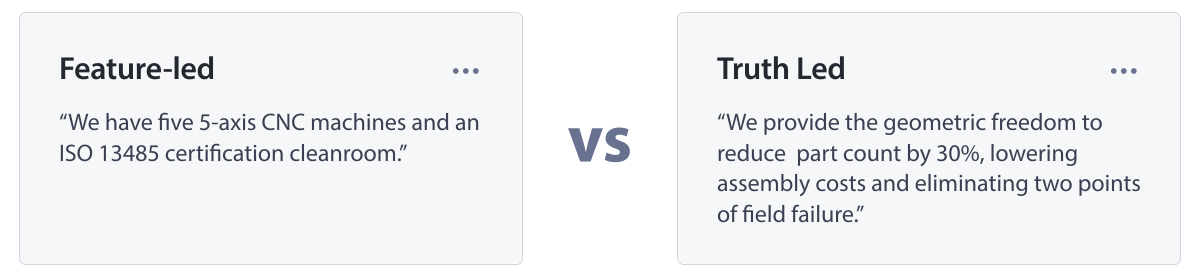
It starts with the feature list. "Five 5-axis CNC machines. ISO 13485 certified cleanroom." True statements. Also, an asset list that any competitor with a comparable equipment schedule can match, sentence for sentence. List your features, and you've made yourself comparable, because a feature list is an invitation to compare.
Confidentiality makes it worse. NDAs and embedded delivery relationships mean the strongest proof of your differentiated capability, the sophisticated programme, and the named customer usually can't be shared publicly. That's a real structural limitation. It's easy for that constraint to become a reason to skip building a differentiated narrative altogether, rather than one that works within it.
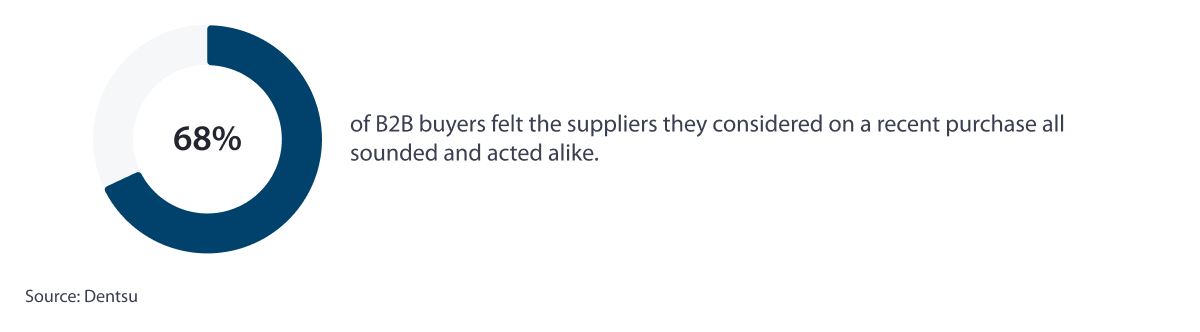
And the market is moving in the wrong direction. Dentsu's buyer research found that 68% of B2B buyers felt the suppliers they considered on a recent purchase all sounded and acted alike, up from 60% two years earlier.
Recent analysis of commoditised segments in contract manufacturing shows exactly where this bites: pricing pressure is worst in areas where differentiation is hardest to demonstrate, such as basic moulding and assembly. Competition is shifting toward capabilities like design-transfer expertise and integrated engineering support, capabilities that resist commoditisation, but only for suppliers who make them visible.
What contract manufacturers in the trap usually lack is translation: the ability to turn what they can genuinely do into something a buyer can actually perceive. That gap is where the trap lives.
There's an objection worth answering directly here: "We don't win work through marketing, we win it through relationships and reputation."
True, and it's carried real weight for decades. But that cover is thinning. Long-standing contacts retire. OEMs consolidate their supplier base and bring procurement into decisions that relationships used to settle alone. Buying committees now include people in quality, procurement, and finance who've never met you, never visited your facility, and have only your commercial presentation to judge you by.
A strong relationship protects the accounts you already hold. It won't get you onto a shortlist forming right now among buyers you've never spoken to. That's exactly where the trap does its most expensive work: where the relationship can't reach.
Why price becomes the only lever left
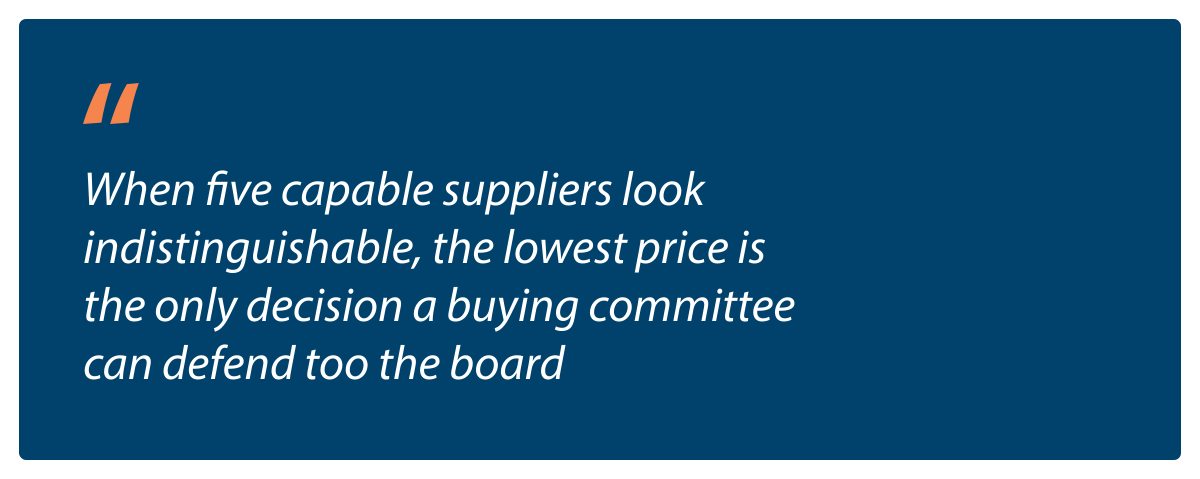
When a buying committee can't find a meaningful difference between suppliers, price stops being their preferred basis for deciding and becomes their only one.
Supply chain analyst. Philip Stoten puts this plainly: OEMs increasingly treat their supply chain as an extension of their own brand, so a supplier failure reflects directly on them. That raises the stakes of the decision without giving the buyer any new information to reduce their risk. Price becomes the visible proxy for a judgement they can't otherwise make with confidence.
The data backs this up. The Dentsu B2B Superpowers Index, drawn from more than 16,000 buyer interviews since 2021, has found the same top driver of B2B purchasing decisions for three years running: "I feel safe signing a contract with them." Not price. Not capability claims. Safety.
That reframes the trap. Sameness has denied buyers every other safety signal, so price is what's left, not because they value it most. When five capable suppliers look indistinguishable, the lowest price is the only decision a buying committee can defend to the board.
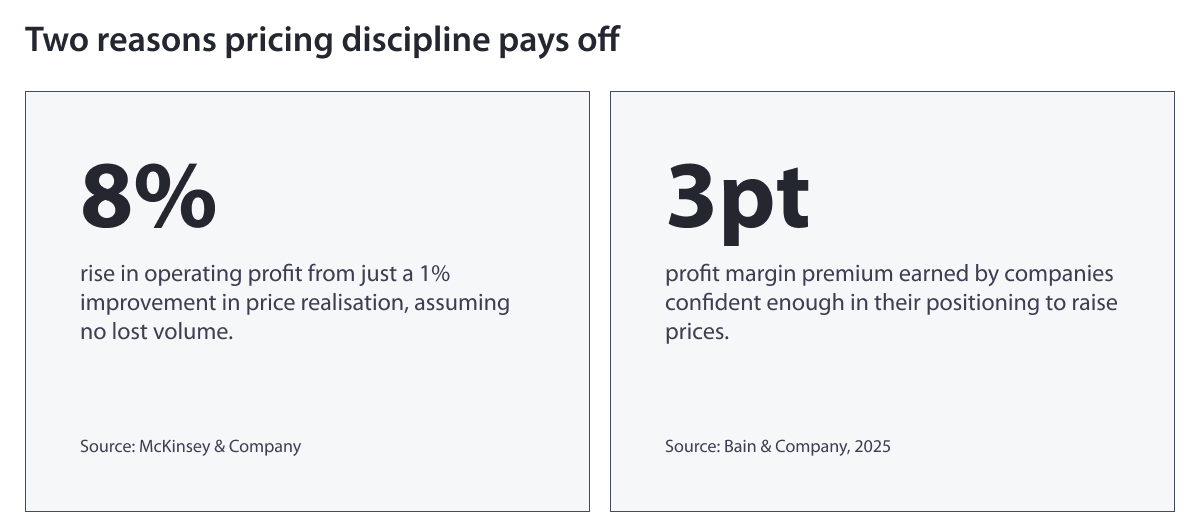
The cost of losing that judgement is real money. McKinsey's pricing research, drawn from across industries, found that a 1% improvement in price realisation delivers an 8.7% increase in operating profit, assuming no loss of volume. That cuts both ways. Contract manufacturers pulled into price-based competition aren't just accepting lower margins on individual deals. They're giving up outsized profit for a discount that may not even be the reason they lost the business.
Bain's 2025 commercial excellence research adds a second data point worth sitting with. Companies confident enough in their positioning to raise prices achieved a 3 percentage-point profit margin premium over those that weren't. In Bain's framing, that confidence wasn't a personality trait in the sales team. It came from having the commercial intelligence and narrative discipline to justify the price being asked.
The commercial system, not weak negotiators, is why contract manufacturers stuck in the trap lack confidence. Their people simply have nothing solid to negotiate from.
More capability won't fix it. Clearer capability will.
The instinctive response to feeling commoditised is to invest in more differentiation at the operational level: another certification, another capital investment, another capacity expansion. Each of these can be a sound business decision on its own terms. None of them touches the trap. The trap is a translation shortfall: turning existing capability into something a buyer can actually weigh up.
That's the difference between a feature and a truth. "We have five 5-axis CNC machines" is a feature. A competitor with the same machines neutralises it instantly. "We provide the geometric freedom to reduce your part count by 30%, lowering assembly cost and removing two field-failure risks" is a truth. It takes a technical fact and turns it into a commercial outcome a buyer can weigh against a competitor's price. The equipment might be identical. The value case isn't.
The same translation works across every service line. A CDMO's feature statement: "GMP-certified suites and 2,000-litre single-use bioreactor capacity." Accurate, and interchangeable with every credible competitor's facilities page.
The truth-led version: "We take your process from tech transfer to validated batches in fewer engineering runs, shortening your route to clinic and reducing the risk of a failed batch during scale-up." Same facility. Now the buyer is weighing time saved and risk removed, not litres, and no rate card has a column for either.
That translation work can't be outsourced to a tool, and you can't produce it faster by adding more marketing activity on top of an unclear position. It takes deliberately extracting what the business genuinely does best, from the people who actually know: engineers, programme managers, quality leads, and turning that into language a buying committee can use to justify choosing you over a comparable-looking alternative.
So, how do you escape the commoditisation trap?
The commoditisation trap does its most expensive damage before a conversation ever starts.
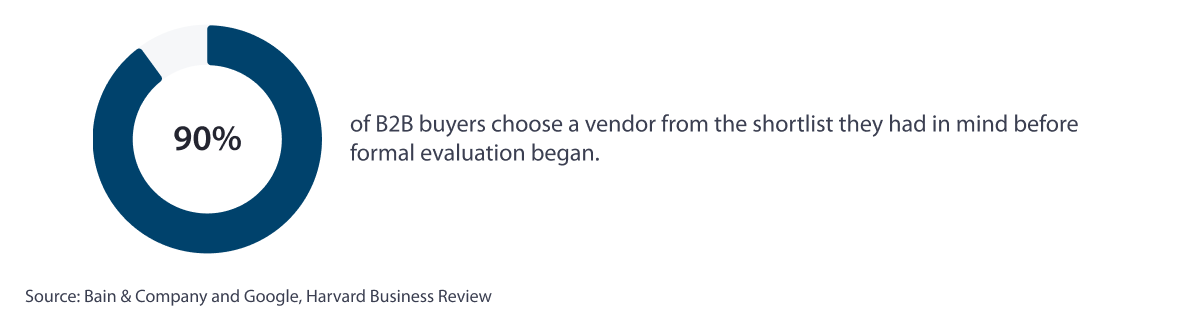
Research published in Harvard Business Review by Bain and Google found that 90% of B2B buyers choose a vendor from the shortlist they had in mind before formal evaluation began. The research phase, in other words, is the decision phase. And that research increasingly runs through AI tools that synthesise supplier information rather than browsing it the way a person would.
An AI-generated supplier comparison is the commoditisation trap, automated. The tool renders each supplier as a table row. If your documented value doesn't survive that compression, the only cell that differs is price. An unclear value narrative no longer just loses the negotiation. It fails to make the shortlist.
Escaping the trap has less to do with winning arguments about price and more to do with removing the conditions that make price the only argument available. Three things need to work together, not in sequence:
- A translated value narrative that connects technical reality to buyer outcomes, specific enough that it can't be matched by reciting a comparable spec sheet.
- Consistency across every touchpoint, website, technical documentation, sales conversation, RFQ response, so a multi-stakeholder buying committee never hits a contradiction that gives them a reason to default back to price.
- A structured, documented foundation that doesn't live only in the head of the one person in the business who's good at articulating it, so the differentiation holds up whoever's in the room.
Before any of that, there's a faster way to find out whether the trap applies to you. Ask yourself the following questions:
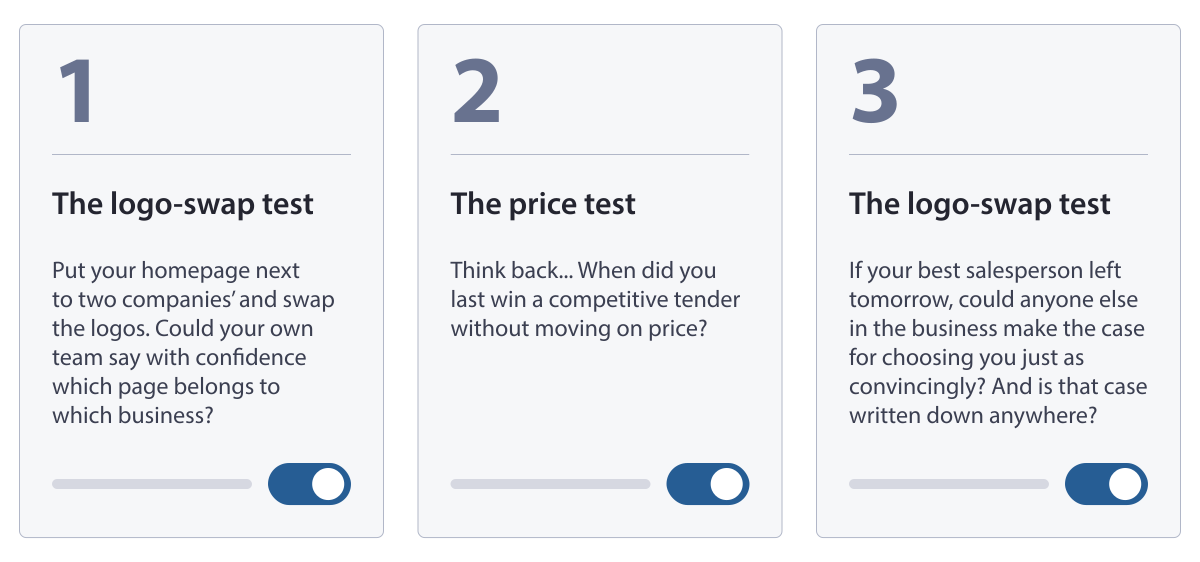
If any of those answers is uncomfortable, the discomfort is data. It tells you the differentiation exists in the business but hasn't been translated into a form the market can perceive.
The trap is optional
Capability across the sector will keep catching up, and that isn't going to change. But nobody commoditises a contract manufacturer from outside. The sector does it to itself, one interchangeable capability list at a time. A well-run business can simply decline to take part.
The contract manufacturers who escape the trap have put in the harder work: translating ordinary capability into a case a buyer can't get from a rate card. That work compounds. It shows up in deals won without a discount, in shortlists made before the phone even rings, and in margin that doesn't quietly leak away because nobody had to justify it.
If this has raised a question about where your business sits, genuinely differentiated, or differentiated but talking like everyone else, the Commercial Systems Workshop gives leadership teams an honest, independent picture of exactly that.

We will send it to your inbox.
Resource Library