
.png?width=16&height=19&name=Icon%20(1).png)


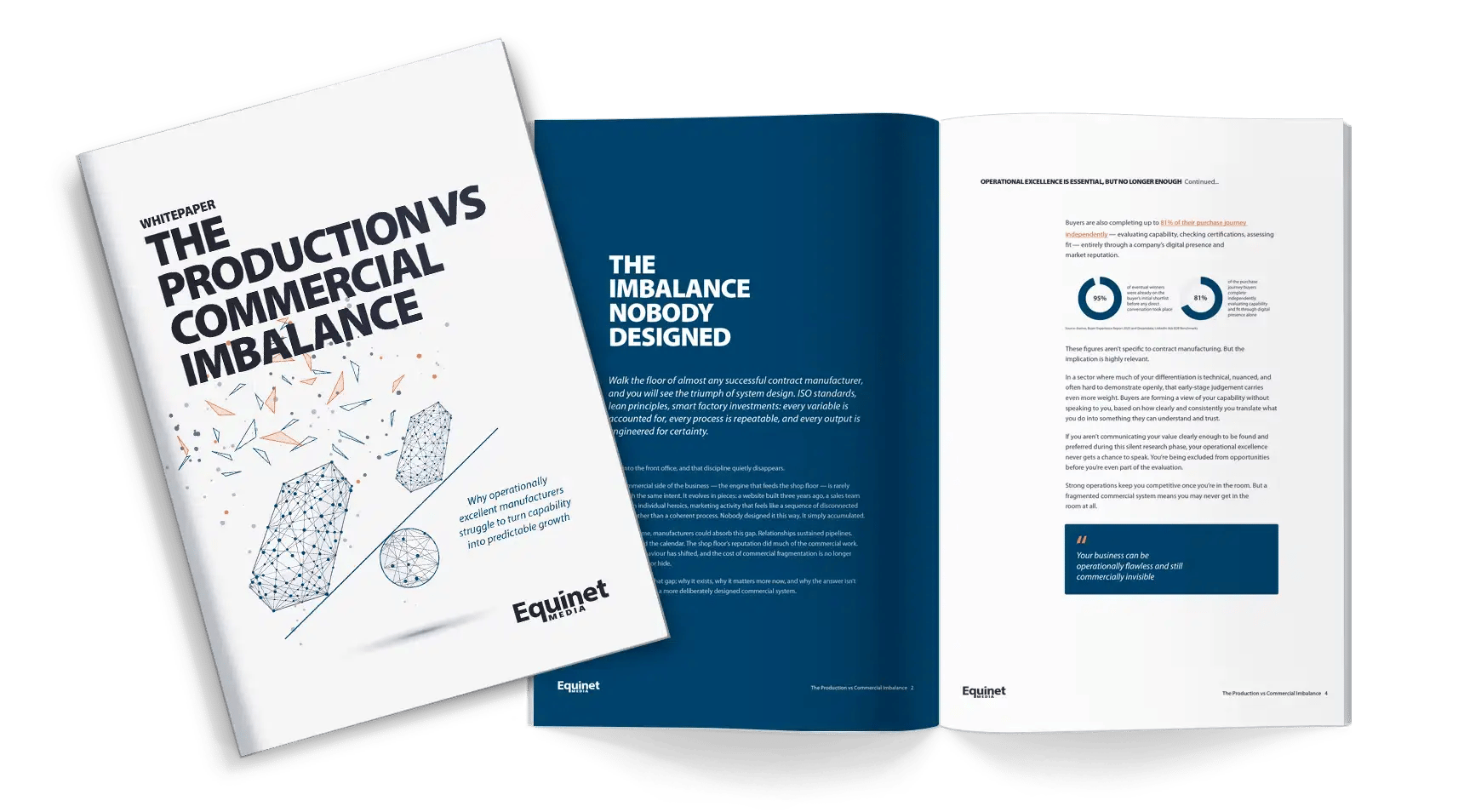
The production vs commercial imbalance
Why operationally excellent manufacturers struggle to turn capability into predictable growth

No time to read now?
The imbalance nobody designed
Walk the floor of almost any successful contract manufacturer, and you will see the triumph of system design. ISO standards, lean principles, smart factory investments: every variable is accounted for, every process is repeatable, and every output is engineered for certainty.
Step into the front office, and that discipline quietly disappears.
The commercial side of the business — the engine that feeds the shop floor — is rarely built with the same intent. It evolves in pieces: a website built three years ago, a sales team relying on individual heroics, marketing activity that feels like a sequence of disconnected projects rather than a coherent process. Nobody designed it this way. It simply accumulated.
For a long time, manufacturers could absorb this gap. Relationships sustained pipelines. Referrals filled the calendar. The shop floor's reputation did much of the commercial work. But buyer behaviour has shifted, and the cost of commercial fragmentation is no longer easy to absorb or hide.
Let's talk about that gap; why it exists, why it matters more now, and why the answer isn’t more activity, but a more deliberately designed commercial system.
Operational excellence is essential, but no longer enough
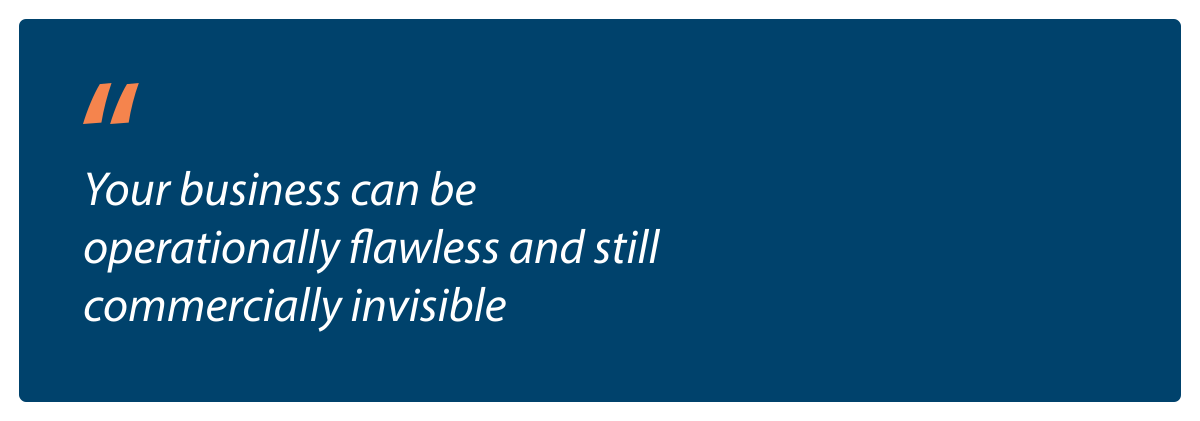
Your business can be operationally flawless and still commercially invisible. That’s a hard truth, but it’s the right place to start.
Contract manufacturers have long treated engineering standards, quality systems, and delivery performance as their primary competitive levers. That instinct is correct. Those strengths remain the price of entry. The problem is that they no longer guarantee pipeline confidence, differentiation, or predictable growth, because they aren’t the things buyers use to build their shortlists.
Before a buyer ever evaluates your quality system or requests a quote, they have already formed a view. That view is shaped by how clearly you communicate what you do, who you do it for, and why it matters — through your digital presence, your positioning, and the consistency of your market reputation.
The market has shifted from discovery to pre-selection. Across B2B, research now shows that 95% of eventual winners were already on the buyer's initial shortlist before any direct conversation took place. In many cases, the supplier chosen was already the buyer’s preferred option before they picked up the phone.
Buyers are also completing up to 81% of their purchase journey independently — evaluating capability, checking certifications, assessing fit — entirely through a company's digital presence and market reputation.

These figures aren’t specific to contract manufacturing. But the implication is highly relevant.
In a sector where much of your differentiation is technical, nuanced, and often hard to demonstrate openly, that early-stage judgement carries even more weight. Buyers are forming a view of your capability without speaking to you, based on how clearly and consistently you translate what you do into something they can understand and trust.
If you aren’t communicating your value clearly enough to be found and preferred during this silent research phase, your operational excellence never gets a chance to speak. You’re being excluded from opportunities before you’re even part of the evaluation.
Strong operations keep you competitive once you’re in the room. But a fragmented commercial system means you may never get in the room at all.
Mind the gap
The problem isn’t that your commercial teams aren’t working hard. Most are. The issue is that they’re working in silos, compensating with effort for what a better-designed system should do automatically.
You can see this in the daily flow of an opportunity. Marketing defines a good lead one way; sales defines it differently. A prospect moves forward, and context is lost between teams. By the time leadership tries to read the pipeline, the picture is already blurred. Nobody is at fault. The structure simply wasn't designed for the journey.
The hidden cost of commercial drag
When the commercial side isn't a designed system, your people end up doing the work the system should be doing for them. That creates a steady structural drain — what you might call commercial drag.
Sales teams spend significant time each week rebuilding materials and reworking messaging, acting as translators of the business rather than focusing on moving opportunities forward with confidence. The content exists somewhere, but it isn't connected, so it gets reinvented instead of reused.
The external cost is just as tangible. In fact, 69% of B2B buyers report finding contradictions between what they read on a supplier's website and what they hear from the salesperson.
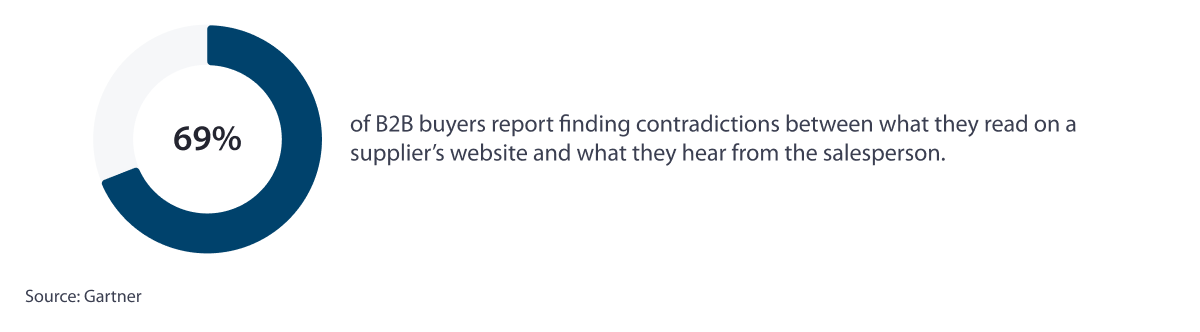
That inconsistency doesn't just confuse. It creates doubt, and in a complex sale, doubt is expensive.
A structural commercial risk
Here's why. Today’s buying groups are becoming more complex. In wider B2B research, decisions often involve large networks of stakeholders, sometimes 13 or more, according to Forrester.
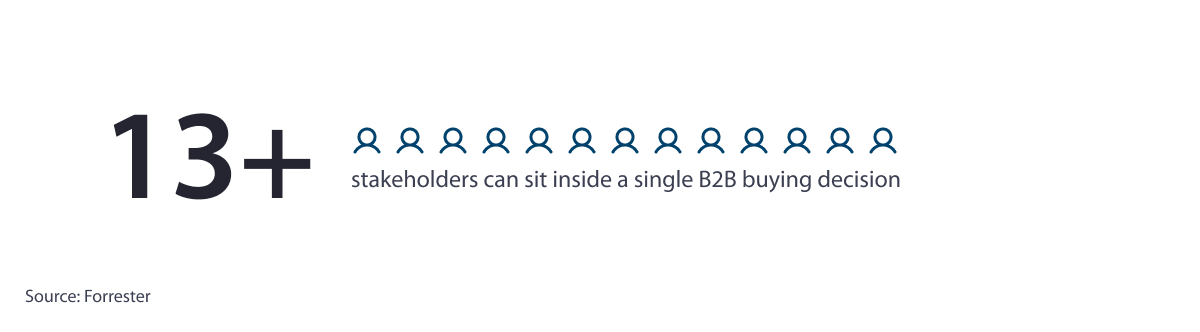
While contract manufacturing decisions may not always reach that scale, the underlying pattern still applies: more voices, more scrutiny, and more chances for inconsistency to slow or derail progress.
When multiple people are involved in a decision, inconsistency is disqualifying. If your digital presence, your sales pitch, and your technical documentation aren't telling the same story, you aren't simply creating noise. You're giving the buying committee the evidence they need to stall the process or move to a competitor.
This reflects a system design issue rather than a performance gap. When the commercial side runs as disconnected fragments, individual talent is forced to compensate for structural weakness. And growth feels like a series of heroic efforts rather than a repeatable, engineered process.
Why does it feel more acute for you?
Every B2B business has some version of this challenge. Contract manufacturers are in a worse position for a specific reason.
Most of your best work is invisible.
Confidentiality agreements, proprietary designs, and embedded delivery relationships mean that the clearest evidence of your capability is the one thing you can’t easily share. You can’t publish the case study from your most sophisticated programme. You can’t display the customer logo that would immediately signal your credibility.
The proof that would typically do the hardest commercial work is locked behind an NDA.
This constraint is becoming more acute as buyer behaviour shifts. Gartner found that nearly 75% of B2B buyers prefer a rep-free experience, doing the bulk of their research quietly before they are willing to engage with a sales team.
For contract manufacturers, that dynamic is particularly challenging.
They're downloading technical specifications, comparing certifications, and assessing lead times long before they make contact. And if they can't find the technical assurance they're looking for during that silent phase, they move on.
Opportunities stall before you even know they exist.
When you can’t show the world what you’re doing, the way you articulate your capability becomes your only real tool for building preference. Clarity has to do the work that public proof usually does.
This is where the front-office gap becomes a direct growth constraint, faster and more severely than in most other sectors. Without a designed system to translate your internal capability into consistent, externally legible decision support, you are fighting with one hand tied behind your back.
And without the visible brand associations that other industries rely on to create familiarity, there is almost nothing to compensate for a lack of commercial clarity.
Why more activity is not the answer
When growth feels stagnant, the instinct is to do more. More campaigns. More content. More tools. More outreach. It feels like decisive action, and it’s easy to justify.
But adding more activity to a fragmented system doesn't fix the fragments; it amplifies them.
This is why martech stacks grow but rarely deliver their full value. In broader B2B research, Gartner found that 73% of buyers now actively avoid suppliers who bombard them with irrelevant outreach. More activity isn’t the same as more progress. If the underlying structure is weak, doing more simply accelerates the production of inconsistency.
The deeper issue is that "do more" treats a system problem as a volume problem. It assumes that the reason growth isn't happening is insufficient activity, when the real reason is insufficient coherence. More content produced from unclear positioning creates more noise. More campaigns sent without a designed follow-through create more leads that disappear. More tools adopted without connected data create more reports that nobody trusts.
This isn't an argument against marketing itself. It’s an argument against adding activity before the foundations are right. The contract manufacturers that grow reliably are not the ones doing the most. They are the ones doing the most coherent thing.
Company truth comes first
A stronger commercial system doesn’t start with a marketing agency, a new platform, or an AI tool. It starts with the truth of the business itself.
In most manufacturing firms, the real value — the reason customers actually stay, the reason programmes run smoothly, the reason relationships deepen over years — lives in the heads of engineers and programme managers. It’s rarely documented, rarely shared beyond the immediate team, and almost never translated into anything the market can actually use.
Moving beyond surface features
Most contract manufacturers operate in a world of features: machine lists, square footage, certifications. These are facts. But they aren’t necessarily truths that drive a buyer to choose you over a competitor who has a similar list.
The difference matters enormously in practice:
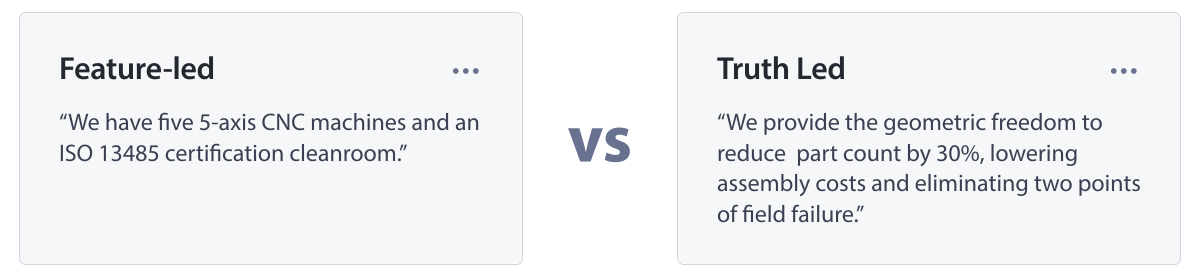
The feature-led approach: "We have five 5-axis CNC machines and an ISO 13485 certified cleanroom." This is an asset list. In a competitive tender, it makes you a commodity because your competitors almost certainly have a comparable one.
The truth-led approach: "We provide the geometric freedom to reduce part count by 30%, which directly lowers your assembly costs and eliminates two potential points of failure in the field." This is a commercial argument. It takes the technical reality and translates it into a risk-reduction and cost-saving outcome for the buyer.
That translation is the work. And it’s the one place where technology has real limits.
AI can help you write the sentences once you know what to say. It can’t walk your shop floor. It can’t identify the specific reason a programme manager trusts you with a particularly complex tolerance. It can’t discover the insight that sits in the relationship between your quality lead and a customer's engineering team. If your captured truth is thin, the entire system built on top of it will be unstable, no matter how sophisticated the tools you use to distribute it.
The diagnostic work of extracting and documenting genuine company truth is the foundation. Without it, the commercial system has nothing real to stand on.
What a stronger commercial system looks like
Understanding the problem is one thing. Knowing what the solution looks like is another.
A stronger commercial system isn’t a collection of services or a stack of tools. It’s a connected architecture. A set of independent layers that each do a specific job, and only deliver value when they work together.
It begins with a strategic foundation: the captured truth of what the business genuinely does best, expressed in terms that mean something to the buyer. From there, it moves into commercial positioning. A clear, consistent articulation of the value you create that can be used reliably across every channel and every interaction.
But positioning on its own isn’t enough. If it isn’t operationalised, it quickly becomes inconsistent and diluted.
That’s why this foundation can’t live in people’s heads. It needs to be captured, structured, and made usable — what you might call digitising your corporate DNA. The knowledge distributed across engineers, programme managers, and quality leads must be translated into a form that the commercial system can actually use.
This includes workshop outputs, technical documentation, process knowledge, and customer insights, all organised into a shared structure that can be consistently applied across marketing, sales, and customer interactions. Without this layer, even the strongest positioning remains fragile because it isn’t supported by anything systematic beneath it.
With that foundation in place, your digital presence becomes a commercial asset rather than a static representation. The website is no longer a digital brochure but a structured resource designed to support buyer progression, meeting prospects where they are and moving them forward with clarity and confidence.
Beyond the website, a customer platform supports decision-making across a complex buying group. It enables multiple stakeholders, each with different priorities, to access the information they need and reach a confident consensus more efficiently.
Growth execution then activates these foundations: targeted content, campaigns, and outreach that reach the right buyers at the right moment with messaging that fits their context. Underpinning this is sales and pipeline visibility — a shared, live picture of where opportunities are, how they are progressing, and where they are stalling.
The final layer is signals and feedback: an ongoing mechanism that reveals what’s working, what isn’t, and where the system needs refinement.
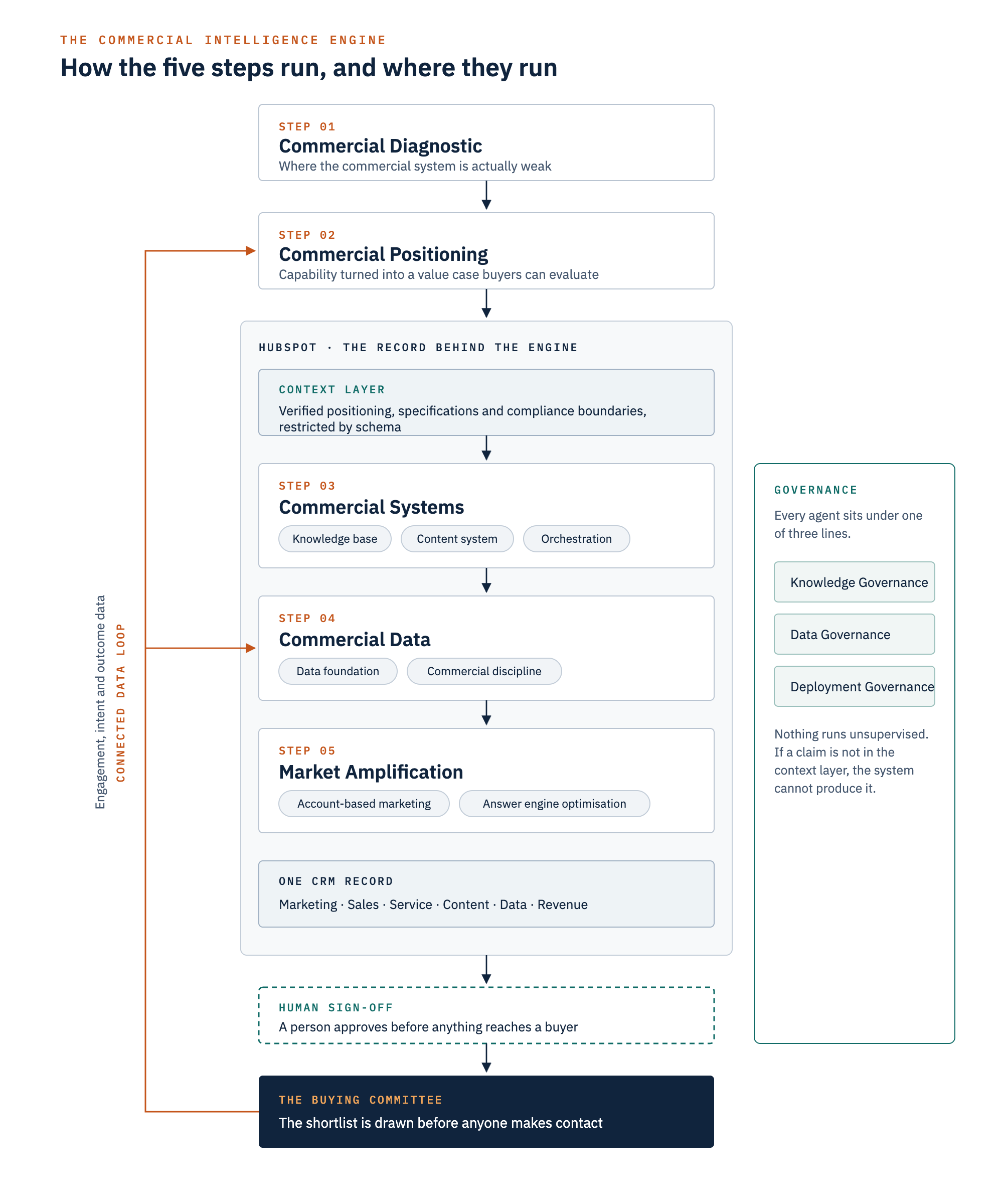
These layers aren’t a sequence of projects. They form a continuous system.
Each depends on the others. The strategic foundation makes the positioning credible. The positioning makes the digital presence coherent. The digital presence supports the sales team. The sales team feeds the pipeline. The pipeline generates signals. And those signals refine the foundation.
That is what makes a commercial system different from a collection of activities. It improves over time because every part of it is designed to learn from the others and compound performance.
Where AI fits — and where it doesn't
AI is currently the loudest part of many commercial conversations. It’s worth keeping it in proportion. The right way to think about AI in a commercial context is as a refinement layer, not a strategic origin. It’s exceptionally valuable for interpreting signals, recognising patterns, accelerating content production, and personalising outreach, but only when it has a working system to refine. Feed AI a weak commercial foundation, and it will produce shallow, generic content faster than any team could before. The problem scales with the tool.
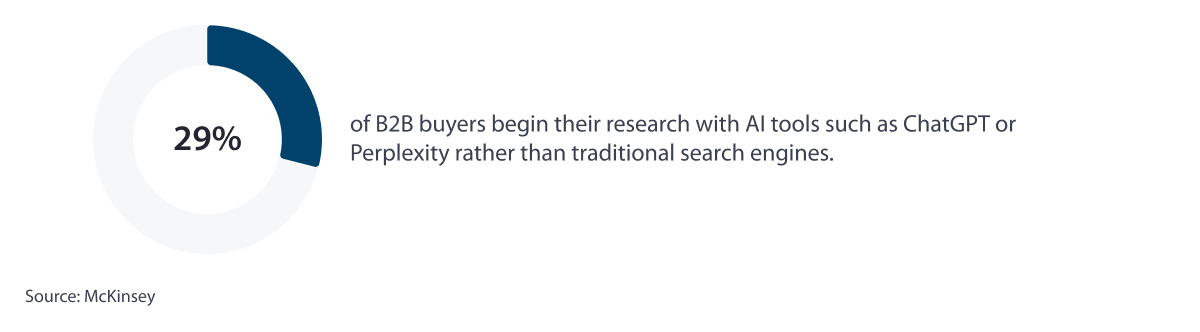
This matters more than ever because AI is now becoming a discovery layer for buyers. Research by McKinsey shows that, as of 2026, nearly 29% of B2B buyers begin their research with AI tools such as ChatGPT or Perplexity rather than traditional search engines.
For contract manufacturers, that shift has specific implications.
These tools don’t browse your website the way a human does. They ingest and synthesise data. If your unique value and technical capabilities aren’t clearly documented and structured, you simply won’t appear in the AI-generated comparisons that buyers use to build their shortlists. Weak clarity doesn’t just fail in Google searches anymore; it fails in AI queries too.
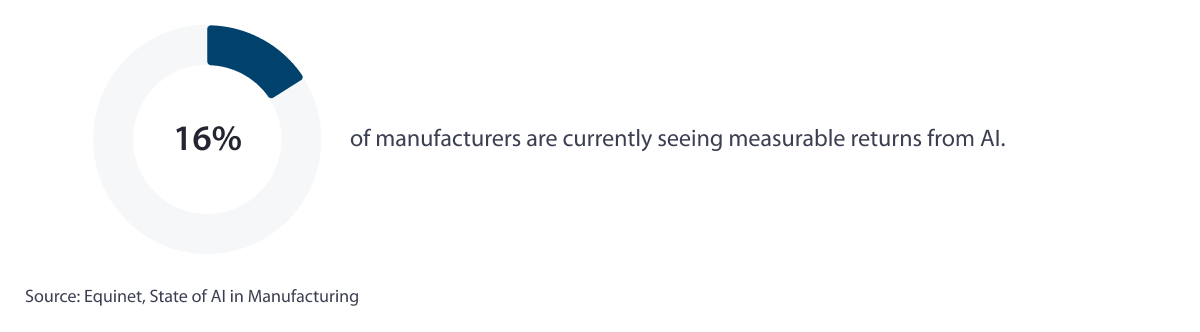
The risk of moving too fast without a foundation is already visible. Equinet's State of AI in Manufacturing report shows that only 16% of manufacturers are currently seeing measurable returns from AI.
This aligns with broader B2B findings. McKinsey reports that a significant proportion of organisations have experienced negative consequences from generative AI, ranging from accuracy failures to reliability issues.
The instruction for contract manufacturing leaders is straightforward: resist starting with AI initiatives. Start with the system foundations that make AI useful. AI can’t tell you what your business genuinely does best. Only you can find that out. Once you have, AI can help you say it better, distribute it further, and learn from how buyers respond.
What leaders should do first
The most sensible first move isn’t a transformation programme. It’s a diagnosis.
Before deciding what to change, you need a shared, honest picture of the current commercial system. Not as it’s supposed to work, but as it actually works.
- Where does the definition of a good opportunity diverge between teams?
- Where does visibility break down as a prospect moves through the business?
- Where are your people compensating for missing structure with personal effort?
- Where does leadership confidence in the pipeline weaken?
These questions are worth asking carefully because the answers are often surprising. Contract manufacturers that feel commercially active — producing content, running campaigns, maintaining a sales team — frequently discover that their commercial system has significant structural gaps that effort has been quietly papering over for years.
Diagnostic work has value in its own right. It stops the guessing. It surfaces the real upstream causes of the symptoms that leadership can already feel: inconsistent lead quality, stalled pipeline, and over-reliance on a handful of key individuals. And it gives the business a foundation for making deliberate decisions rather than reactive ones.
This isn’t about finding fault. It’s about understanding what you are actually working with before you invest further in fixing or scaling it.
Fix the front end before you optimise it
You’ve already proved that systems work. On the shop floor, you know that discipline, design, and connection are what produce predictable results. You know that effort without structure is not a sustainable substitute.
The same logic applies to how you find and keep customers.
In today's market, operational strength is the foundation. But a designed commercial system is what turns that foundation into reliable growth. Buyers are completing most of their journey before they speak to you. They’re using AI to build shortlists. They’re likely not making decisions alone. They’re looking for consistency and clarity, and are ready to disqualify on either basis.
The contract manufacturers that win aren’t simply the most operationally excellent. They’re the ones who are also the most commercially legible.
Fix the front end before you try to optimise it. Build from company truth. Design the system before you scale the activity. And you will find that growth becomes as predictable as your production line.
If this has prompted you to think differently about the commercial side of your business, a good next step is to get a clearer picture of where your current system is strong and where it has gaps.
The Commercial Systems Workshop is designed to give leadership teams exactly that — a structured, independent diagnosis of the commercial system as it actually works today, and a foundation for deciding what to address first.

We will send it to your inbox.
Resource Library