.png?width=16&height=19&name=Icon%20(1).png)




 6
6In manufacturing and technical B2B businesses, marketers are often working under intense pressure. Sales cycles are long. Scrutiny is high. Proving impact is difficult. One strategic shift can make a disproportionate difference: buying committee marketing.
This approach starts from an uncomfortable truth. Marketing in complex B2B environments carries an unspoken contradiction. Sales cycles are long, complex, and high-risk. Decisions can take months and involve multiple departments, including procurement, engineering, operations, finance, and leadership. No one signs off lightly.
Yet marketing is still frequently planned as if influence happens in tidy, linear bursts. A campaign here. A content push there. A lead handoff at a defined moment. The problem is not a lack of effort or ability. Most marketers in these environments are capable, thoughtful, and deeply committed to their work. The problem is structural.
Marketing is organised around activities. Buying decisions unfold as processes. Until those two realities align, marketing will continue to struggle to demonstrate its true commercial value.
The myth of the “decision-maker”
One of the most persistent myths in B2B marketing is the idea that there is a single decision-maker to persuade. Even when teams acknowledge the existence of buying committees, planning still tends to revolve around a dominant role: the economic buyer, the technical lead, or the senior sponsor.
In practice, manufacturing decisions rarely hinge on the conviction of a single person. They depend on collective confidence.
One individual may initiate the conversation. Others validate it, pressure-test assumptions, raise concerns, delay progress, or quietly veto the decision altogether. Agreement builds gradually, often through informal conversations rather than formal approval stages.
Marketing that focuses on converting one role without supporting this broader internal conversation often creates interest without momentum. Sales conversations begin. Engagement looks promising. But decisions stall. This is why marketing activity can appear successful while its impact on revenue remains difficult to prove.
Marketing operates inside buying systems, not funnels
In complex B2B environments, buying behaviour is better understood as a system than a funnel. People enter and exit the conversation at different times. Information flows sideways as much as forward. Progress is uneven, and regression is a common occurrence.
An end-to-end buying committee approach begins by accepting this reality rather than fighting it. Instead of asking, “How do we generate more leads?” the question becomes a more fundamental one. “How do we support the decision-making process from first interest to final approval?”
That shift has far-reaching implications. Marketing stops being a series of outputs and becomes part of the commercial infrastructure. It becomes the environment in which buyers educate themselves, align internally, and reduce perceived risk.
Seen this way, the value of an end-to-end approach is not theoretical. It is practical, operational, and directly connected to how deals actually close.

Early-stage marketing is about visibility, not conversion
In the early stages of a buying journey, most prospects are not actively seeking to make a purchase. They are trying to understand. They are forming an initial sense of whether a supplier feels credible, relevant, and safe enough to explore further.
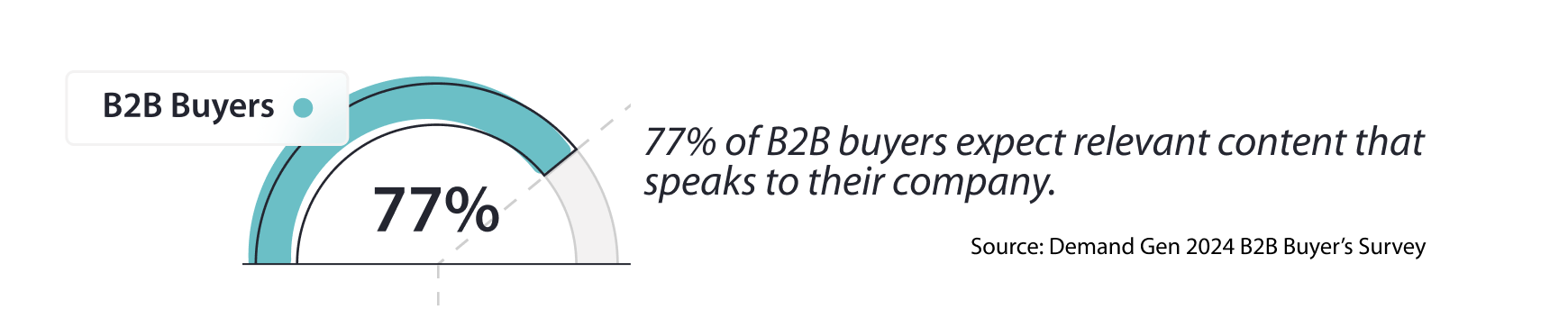
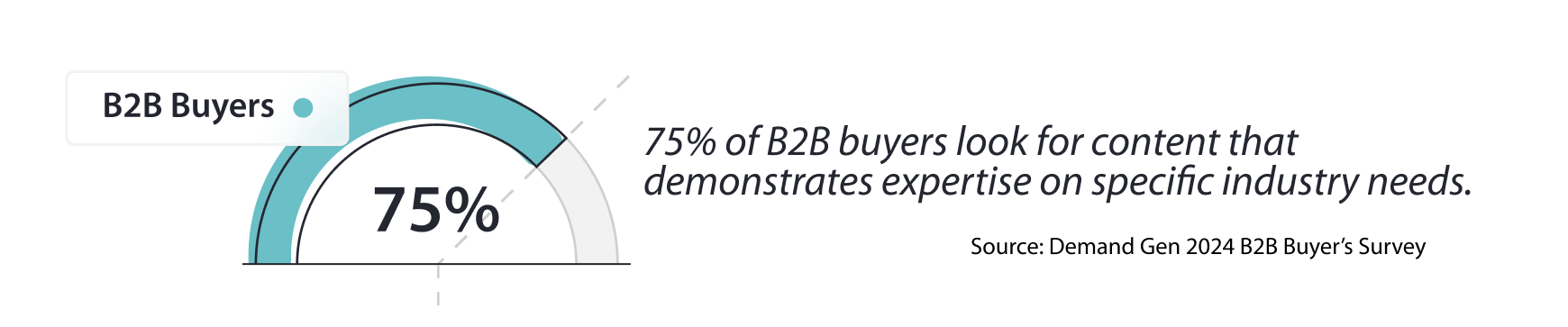
Research from Demand Gen shows that when browsing a potential supplier’s website, 77% of B2B buyers expect relevant content that speaks directly to their company, and 75% look for content that demonstrates expertise around specific industry needs. Only 62% are interested in pricing information. At this point, marketing’s role is not persuasion. It is orientation.
Different stakeholders will encounter your business through different routes. An engineer may look for technical reassurance. A commercial lead may seek differentiation or proof of experience. A senior leader may scan for signals of stability and professionalism.
When marketing is designed deliberately, these early encounters reinforce one another. Each touchpoint contributes to a coherent impression that holds up regardless of who is viewing it or why.
This coherence allows sales conversations to begin on firmer ground. Instead of correcting misconceptions or rebuilding credibility, sales can build on a foundation that marketing has already established.
The middle of the journey is where most marketing quietly fails
The most fragile stage of a complex buying journey is not the beginning or the end; it is the middle. This is where internal conversations begin. Prospects share links with colleagues. They reference what they have seen or read. They ask each other, informally, whether a supplier feels credible or risky. It is also where marketing often takes a back seat.
Activity slows. Attention shifts back to lead generation. The assumption is that sales is now handling it. In reality, this is when marketing’s influence matters most.
An end-to-end approach ensures that the story holds together wherever and however it is encountered. Claims made in sales conversations are reinforced by what buyers see when they conduct independent research. Objections are addressed quietly, before they harden into resistance.
Marketing is not pushing at this stage. It is stabilising confidence. When this works, deals progress without drama. When it does not, they stall for reasons that are difficult to diagnose and impossible to attribute to any single action.
Late-stage decisions are about risk, not excitement
By the time a buying committee approaches a decision, enthusiasm is rarely the limiting factor. Risk is. In manufacturing, supplier choices carry operational, financial, and reputational consequences. Late-stage buyers are not asking whether a solution sounds good. They are asking whether it works. They are asking whether it is defensible.
They want to know whether others like them have succeeded. They want to see consistency over time. They want reassurance that nothing unexpected will surface after contracts are signed. If marketing withdraws at this stage, sales carries the burden alone.
When marketing remains present, quietly reinforcing credibility, it shortens deliberation, reduces hesitation, and makes decisions easier to justify internally. This is one of the least visible contributions marketing can make, and one of the most valuable.
Why end-to-end marketing changes the internal conversation
Adopting an end-to-end buying committee approach not only changes how marketing works externally, but also how it works internally. It also changes how marketing is discussed internally. Instead of reporting on isolated campaigns or channels, marketing can explain its role in supporting the entire buying process.
Performance conversations shift from “Did this campaign work?” to “Did this stage of the journey move forward?” That reframing brings marketing closer to sales and leadership. It anchors decisions in commercial logic rather than creative preference. It makes trade-offs clearer and priorities easier to defend.
Most importantly, it gives marketers confidence that their work is connected to real buying behaviour, not just activity metrics.
End-to-end does not mean more. It means more deliberate.
One of the most common objections to end-to-end approaches is that they sound complex or resource-heavy. In practice, the opposite is often true. When marketing is designed end-to-end, duplication drops. Random activity disappears. Effort concentrates around the moments that actually matter in the buying process.
Instead of constantly asking, “What should we do next?” the question becomes, “What does the buying committee need now?” That clarity simplifies decision-making and reduces noise. It replaces reactive marketing with intentional support.
The central truth
Buying committees do not move in campaigns. They move in confidence, alignment, and perceived safety. Marketing that supports these conditions end-to-end does not rely on hype or heroics. It does not demand perfect attribution. It works because it mirrors how decisions are actually made in complex B2B environments.
For marketers operating in long-cycle, high-risk industries, an end-to-end buying committee approach is not advanced theory. It is the foundation for real marketing impact.
And once you see marketing this way, it becomes very difficult to go back.
Book a call with our B2B marketing experts now to find out how to implement a buying committee-driven approach in your marketing strategy.