

The leadership perception gap
Why leadership teams in contract manufacturing see the same commercial system differently, and why that comes first


No time to read now?
One business, several pictures
Ask the CEO of a contract manufacturer how the commercial side of the business is performing, and you will get a clear answer. Ask the Commercial Director, the sales lead, and the marketing lead the same question, separately, and you will get clear answers from them too.
They will rarely be the same answer.
Each person is describing the same commercial system. Each is drawing on real data and real experience, and each view holds together on its own terms. Each is also partial, because everyone sees the system from where they sit. The CEO sees it through revenue, forecast, and board conversations. The Commercial Director sees it through key accounts and pricing. Sales sees live opportunities and objections. Marketing sees enquiries, engagement, and requests from the sales team.
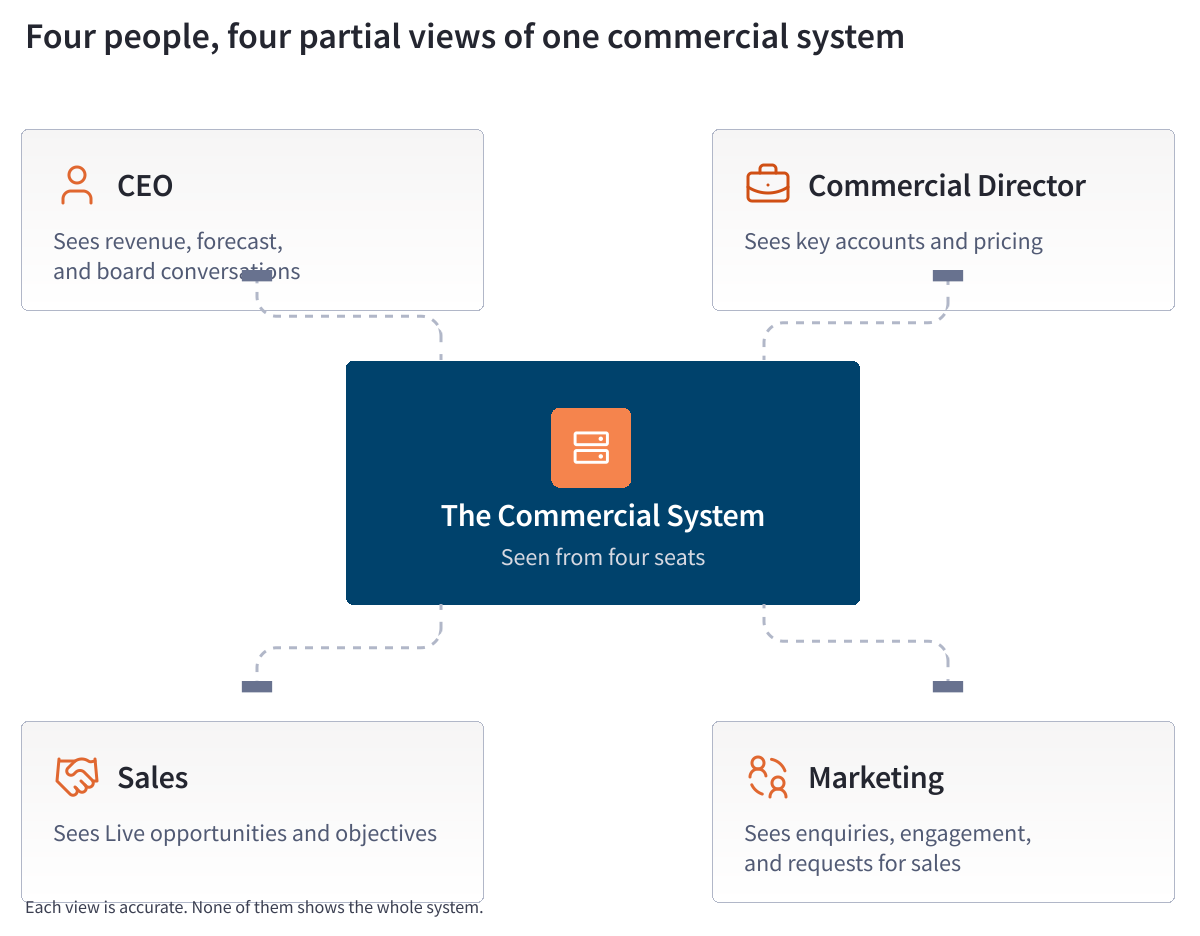
That difference in view is the leadership perception gap. It is rarely discussed, because most leadership teams assume they already share a picture. They meet regularly, review the same numbers, and agree on targets. The assumption feels safe.
Agreeing on the numbers and agreeing on what sits behind them are two different things, though. This guide looks at why the gap forms, where it tends to show, what it costs, and how to measure it before deciding what to fix.
Why the front office has no single version of the truth
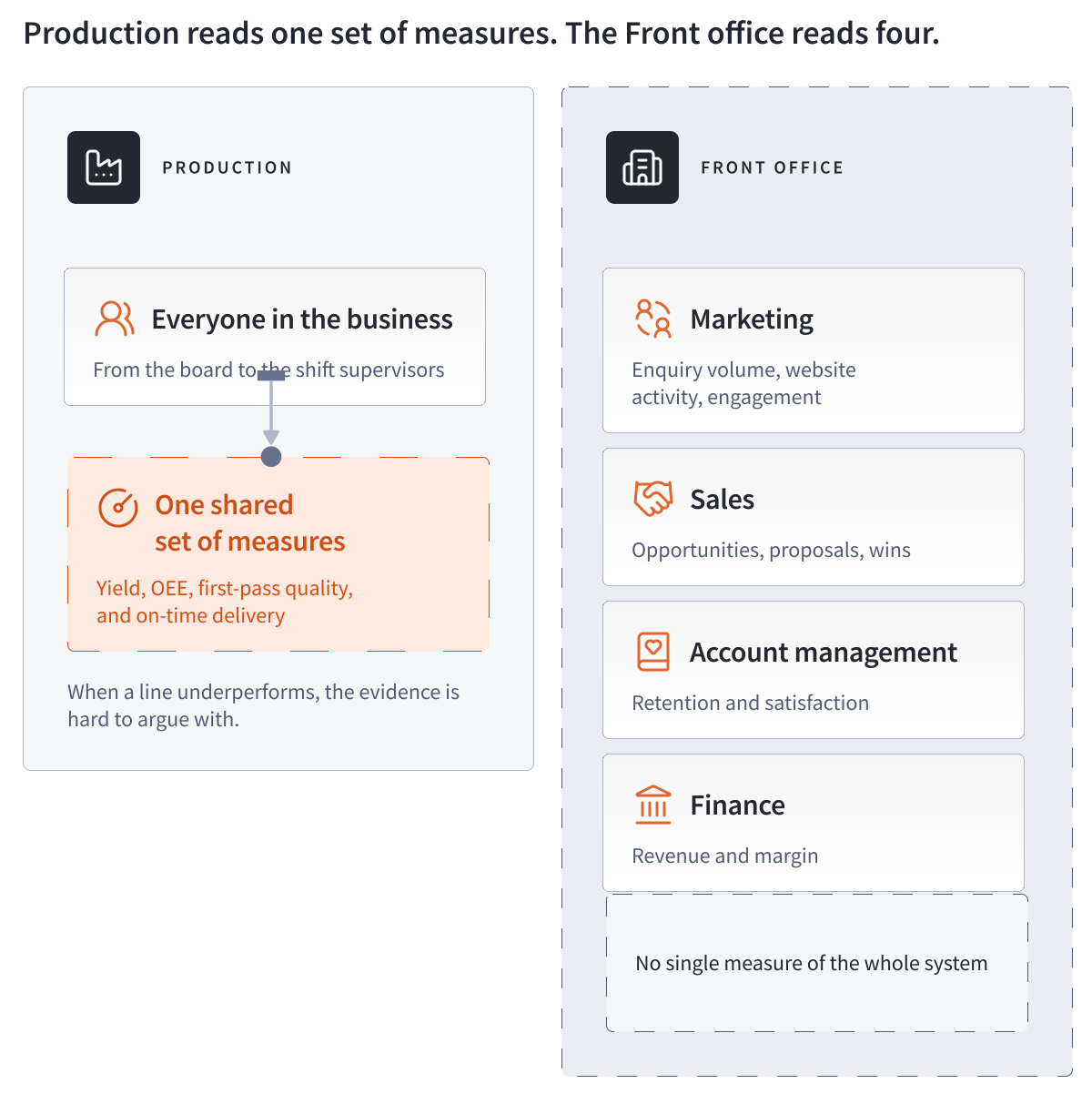
On the production side, the business runs on shared measures: yield, OEE, first-pass quality, and on-time delivery. Everyone from the shift supervisor to the board reads the same figures and broadly agrees on what they mean. When a line underperforms, the evidence is hard to argue with.
The front office has no equivalent. No single measure tells a leadership team how well the business finds, wins, and grows customers. Instead, each function measures its own part.
Marketing reports enquiry volume, website activity, and engagement. Sales reports opportunities, proposals, and wins. Account management reports retention and satisfaction. Finance reports revenue and margin. Each set of figures is accurate. None of them describes the whole system, and none shows how one part affects another.
As The cost of a hidden expertise bottleneck sets out, each team captures intelligence in its own format, structured around its own KPIs. The same is true of how each team sees the commercial system. People form their picture from the data they work with every day. When the data is divided, the pictures divide with it.
Language widens the gap. Words like "qualified", "pipeline", "key account", and "differentiated" come up in every leadership meeting. They sound shared. In practice, each function often defines them slightly differently, and nobody notices because nobody stops to check. The production vs commercial imbalance shows how this plays out in the definition of a good lead. The same thing happens at leadership level, across every term the business uses to judge its own performance.
Five places to look
The gap can sit anywhere, but some questions are more prone to it than others. These five matter most, because the answer to each one shapes where the business puts its time and money.
1. What makes the business different
Ask each member of the leadership team, separately, why the best customers choose the business. Each answer will usually reflect the speaker's own part of the business: technical depth, responsiveness, track record, or long-standing relationships. All of these may be true.
If leadership gives four different answers, though, the website, the sales team, and the RFQ responses will give four different answers too. The avoidable commoditisation trap explores what happens when buyers can't tell suppliers apart. Disagreement at the top is often where that starts.
2. What a good opportunity looks like
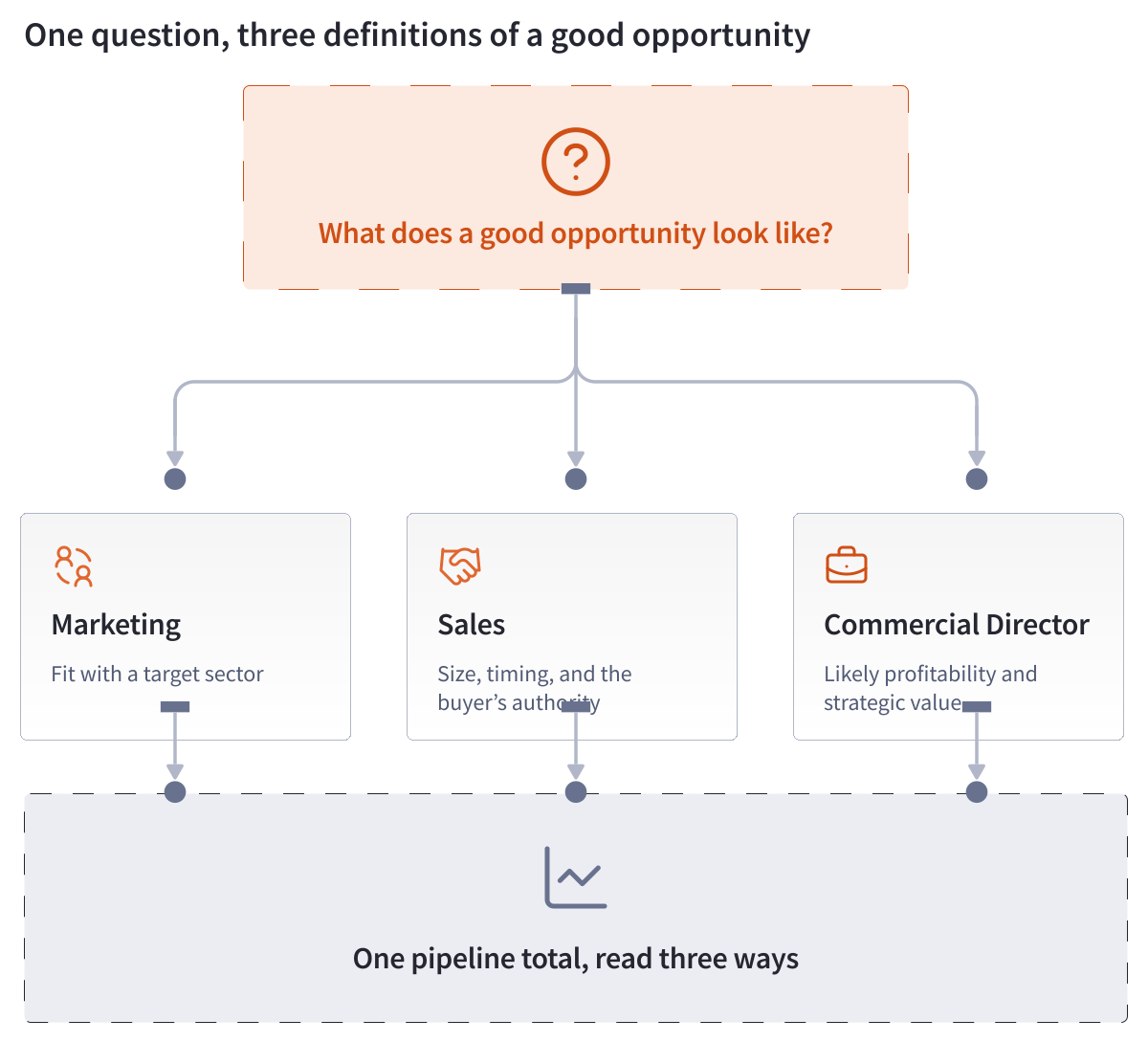
Marketing may judge an enquiry by its fit with a target sector. Sales may judge it by size, timing, and the buyer's authority. The Commercial Director may judge it by likely profitability and strategic value.
When those criteria aren't written down and agreed, the pipeline holds opportunities that each function would score differently. Leadership then reads a total that means different things to different people.
3. How confident to be in the pipeline
Confidence in the forecast tends to vary with distance from the detail. Those closest to individual opportunities know which ones are fragile. Those further away see a total.
Both views are reasonable. When the difference between them goes unspoken, plans for hiring, capacity, and investment rest on a level of confidence that only part of the team holds.
4. What marketing is for
In many contract manufacturers, marketing has grown up as a support function. It produces datasheets, updates the website, prepares for trade shows, and responds to requests from sales. Some leaders see that as its job. Others expect it to generate demand. Others again see it mainly as a cost.
These expectations are rarely set out side by side. Marketing can then be judged against a goal nobody stated, and the leadership team can disagree about its value without realising they are measuring different things.
5. Where the next phase of growth comes from
Growth can come from new customers, deeper existing accounts, new sectors, or new capabilities. Most leadership teams would say all four. Asked to rank them, individuals often order them differently.
Each ordering implies a different commercial system, with different targets, different content, different data, and different skills. A team that hasn't agreed the order is, in effect, building towards several plans at once.
What the gap costs
The perception gap rarely causes a visible failure. Its cost shows up in four quieter ways.
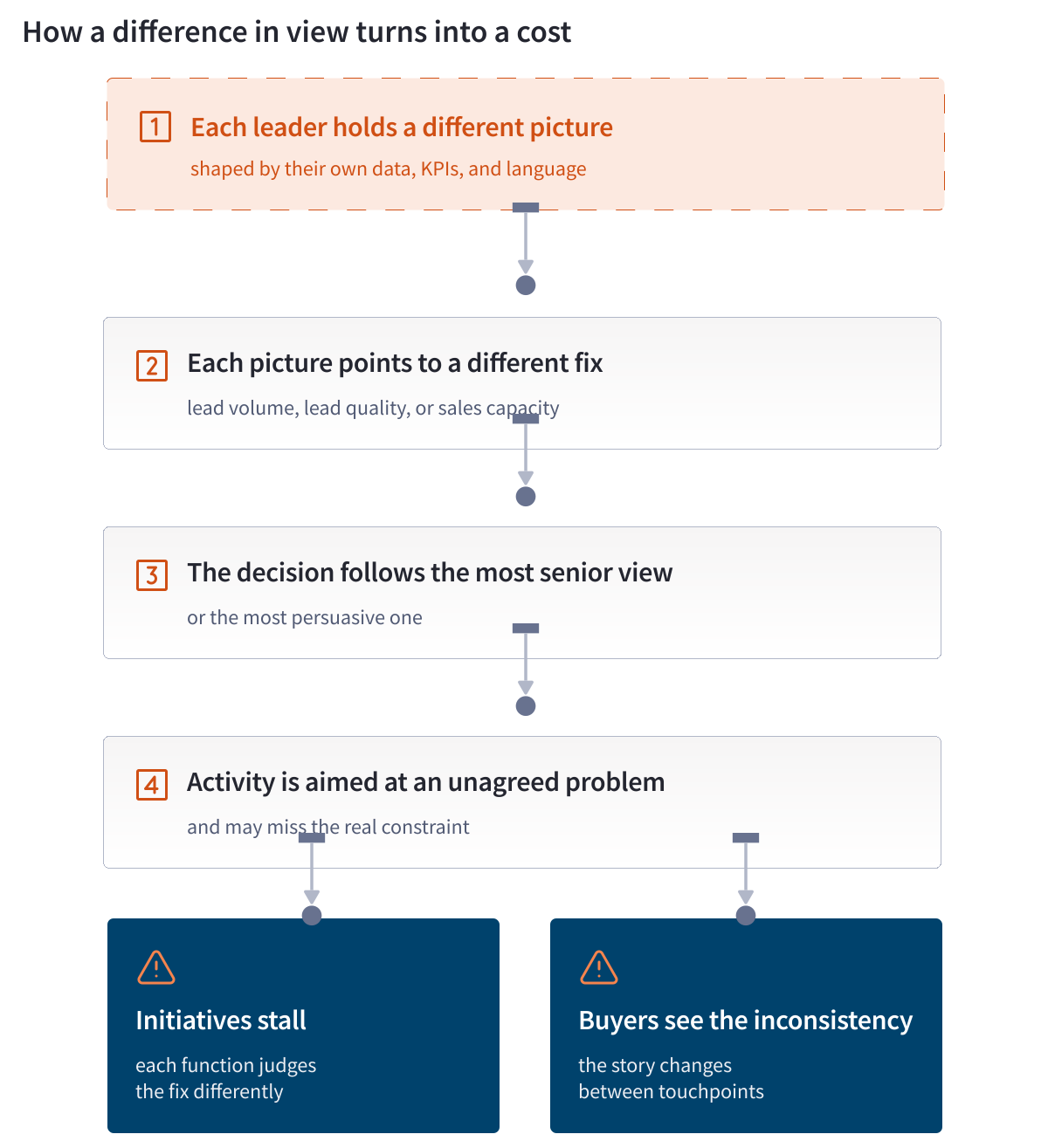
Investment goes to the wrong constraint
Suppose marketing believes the problem is lead volume, sales believes it is lead quality, and the CEO believes it is sales capacity. Each will argue for a different fix. The decision usually goes to the most senior view, or the most persuasive one, and neither guarantees it addresses the real constraint.
What tends to follow is more activity aimed at a problem the team never agreed on. Why more activity is not the answer covers where that leads.
Initiatives stall
A new CRM process, a positioning project, or a website rebuild needs every function to agree on what it is for. When each function holds a different picture of the problem, each judges the solution against a different standard. Progress slows, and the initiative takes the blame for a disagreement that existed before it started.
Buyers see the inconsistency
Differences in view rarely stay inside the business. They surface in how the business describes itself across its website, its sales conversations, its technical documentation, and its RFQ responses. A buying committee reading those side by side will notice where the story changes, as The production vs commercial imbalance sets out.
The picture concentrates on a few people
When no shared view exists, the most complete picture tends to sit with one or two individuals. They are usually the people who have been in the business longest, or who sit across several functions. That works until they are unavailable. At that point the rest of the team discovers how much of the picture it never held.
Why the gap is hard to see from the inside
If the gap carries a cost, why don't leadership teams spot it themselves? There are three reasons, and all of them are structural.
Meetings reconcile numbers, rarely assumptions. Leadership reviews are built to agree figures and actions. They are seldom designed to test whether everyone means the same thing by those figures. Two people can sign off the same forecast while holding very different beliefs about how likely it is to land.
Hierarchy shapes what gets said. When the CEO asks how things are going, people answer in front of the CEO. Views get softened, rounded up, or held back, usually with good intentions. The most senior person in the room often hears the most consistent story, and has the least sight of where it differs.
Every function reviews itself. When a business reviews its commercial performance internally, each part is assessed by, or alongside, the people who run it. That is natural, and it makes candour harder. Differences between functions are easier to raise when someone outside the reporting lines is asking the questions.
These are features of how leadership teams work in any sector. They say nothing about the quality of the people involved.
Measure the agreement before you trust the measurement
Any quality lead will recognise the principle. Before a measurement system is trusted, it is tested. A gauge repeatability and reproducibility study checks whether different appraisers, measuring the same part, get the same result. Where they don't, the variation sits in the measurement, and decisions based on that data are unsafe until it is resolved.
The same principle applies to the front office. Before deciding what to change in the commercial system, a leadership team needs to know whether its members are measuring it the same way. Where they agree, the shared view can be relied on. Where they differ, the difference is itself the finding.
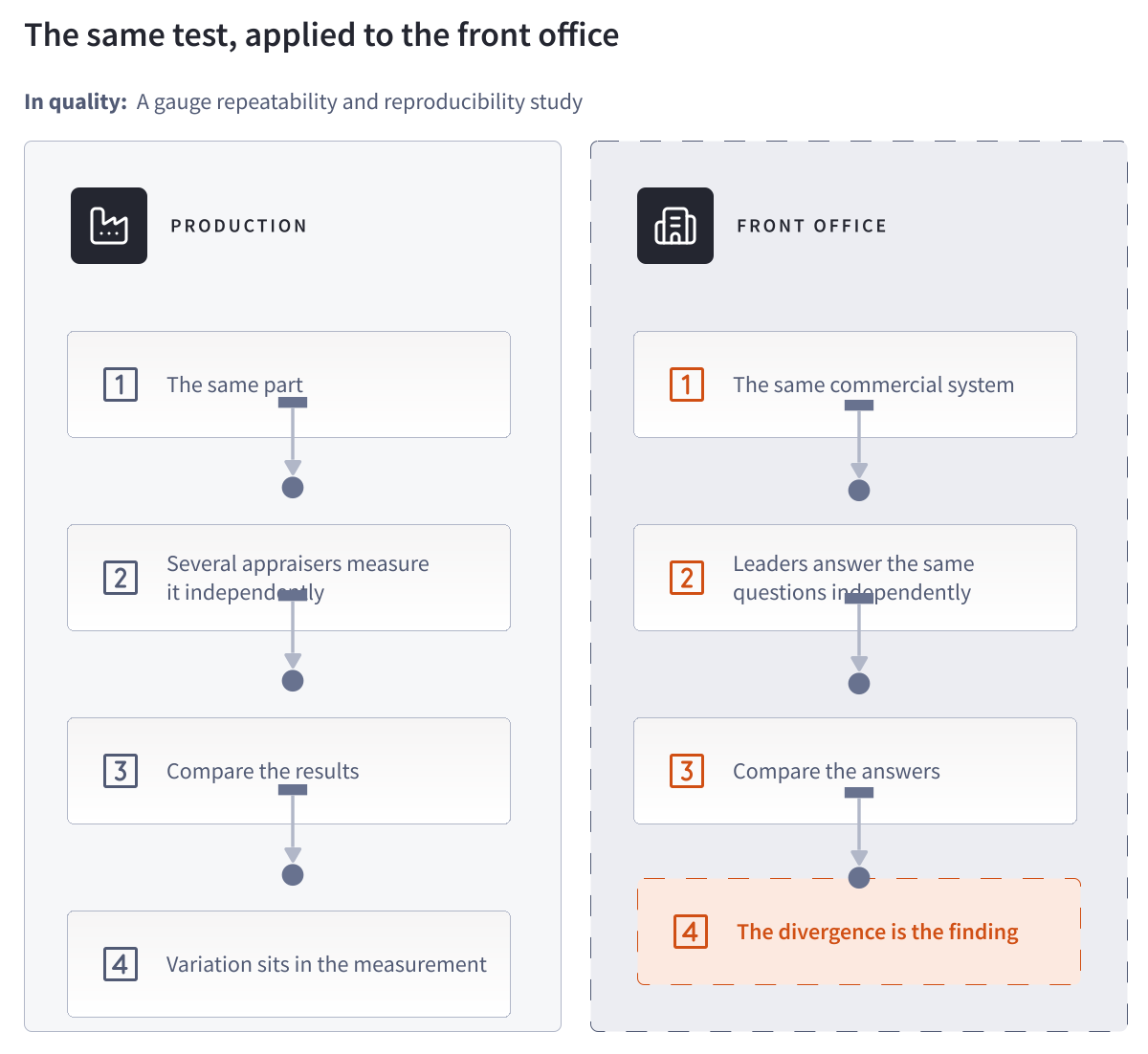
Measuring that agreement takes three things.
Independent answers first. Each person responds to the same questions separately, before any discussion. That stops the first opinion voiced from anchoring everyone else's.
The right people. At minimum, the CEO, the Commercial Director, and the leads for sales and marketing. Add account management, operations, or finance wherever they shape the commercial picture.
Discussion focused on difference. Once the responses are in, the useful conversation is about where views diverge and why. Where everyone agrees, there is little to discuss. Where they don't, the reasons usually reveal how the commercial system works in practice.
A test you can run this week
You can find out whether a gap exists without a workshop. Before your next leadership meeting, ask each member of the team to answer these five questions in writing, separately, without conferring.
- In one sentence, why do our best customers choose us?
- What does a good opportunity look like for us?
- Out of 10, how confident are you in the pipeline for the next two quarters?
- What is marketing's main job here?
- Where will most of our growth come from over the next three years?
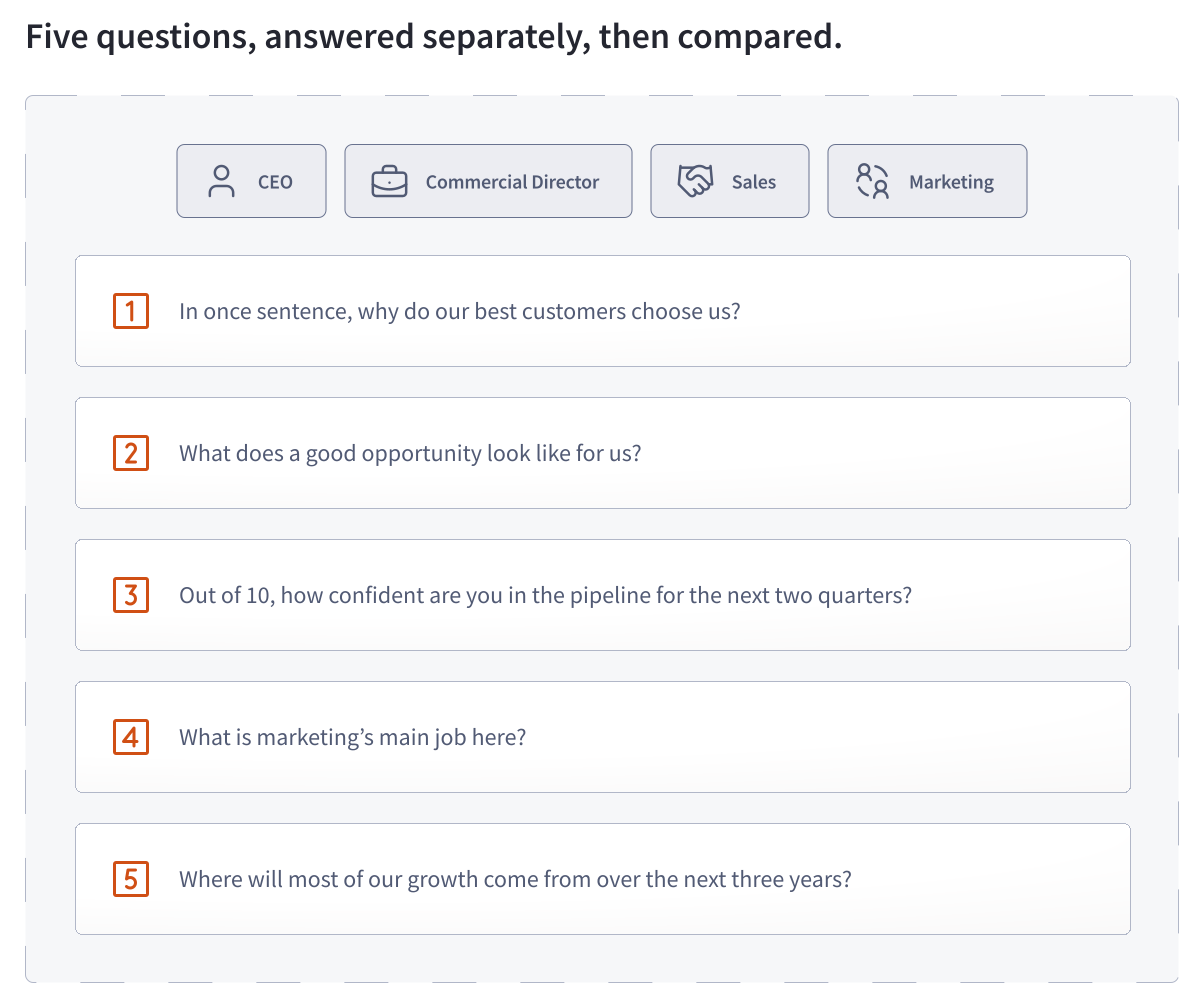
Then put the answers side by side.
If they broadly match, that is worth knowing, and it gives you a firmer base for whatever you decide next. If they differ, the differences show you where to look first. Either way, the team will know more about its own commercial system than it did before the meeting.
Agree on the picture, then choose the fix
Every contract manufacturer reaches a point where the commercial side needs attention. The harder question is where to start. It might be positioning, the systems that carry it, the data that connects teams, or how the business reaches its market. Each is the right first step for some businesses and the wrong one for others.
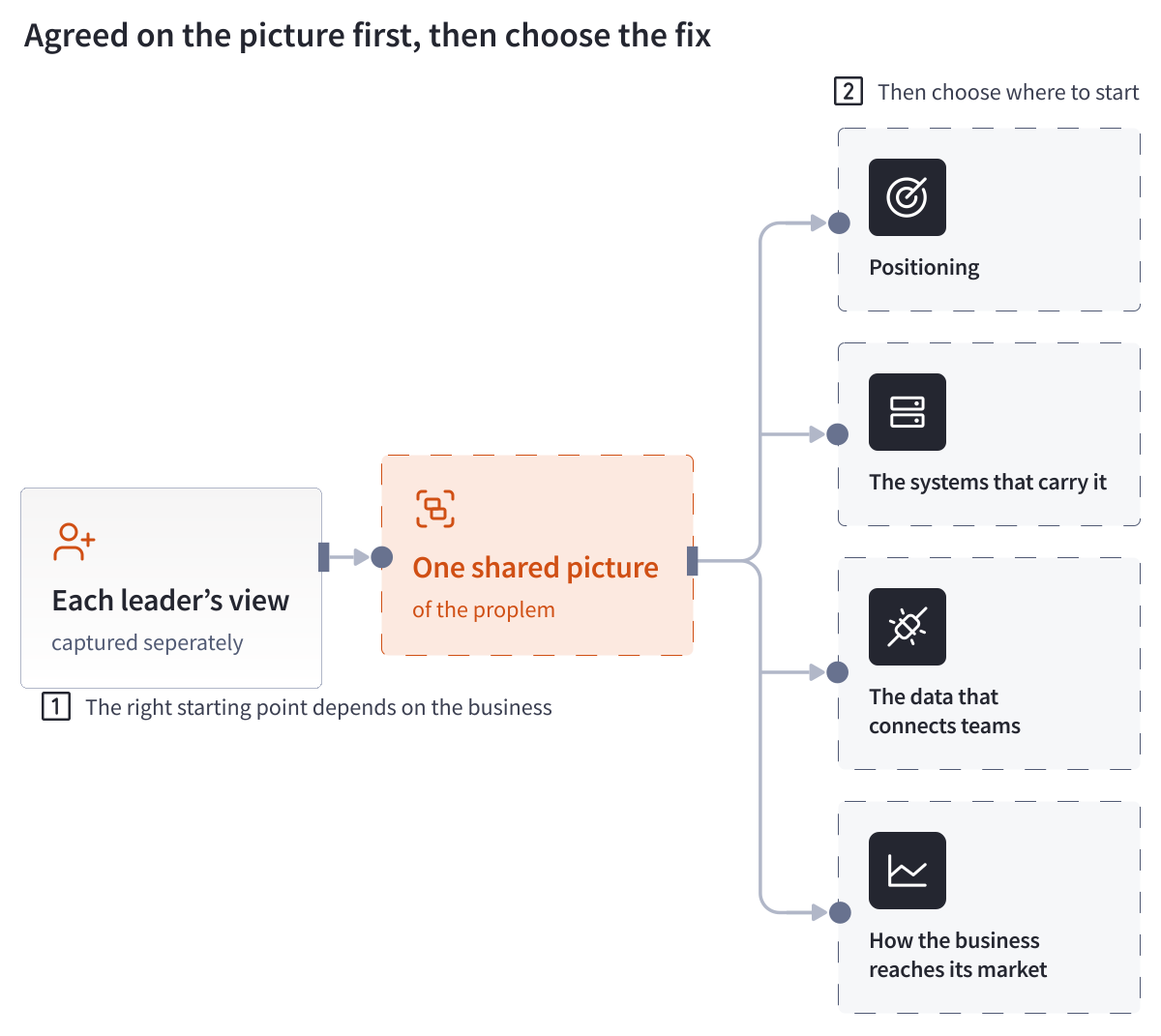
The right starting point depends on the business. A leadership team can only identify it once its members share a view of the problem. Agreement on the picture comes before agreement on the fix.
The Commercial Diagnostic is designed to establish that shared picture. Selected stakeholders complete a short survey before the workshop, so each view is captured independently. Eric Swain, who has facilitated more than 100 senior-team workshops since 2012, then leads a 90-minute session with the leadership team. It focuses on where confidence is weak, where views differ, and where the clearest opportunities lie. Afterwards, you receive a written summary of the findings and the most sensible next step.

We will send it to your inbox.
Resource Library